
Chapter 4
Energy Management: Mastering Altitude and Airspeed Control
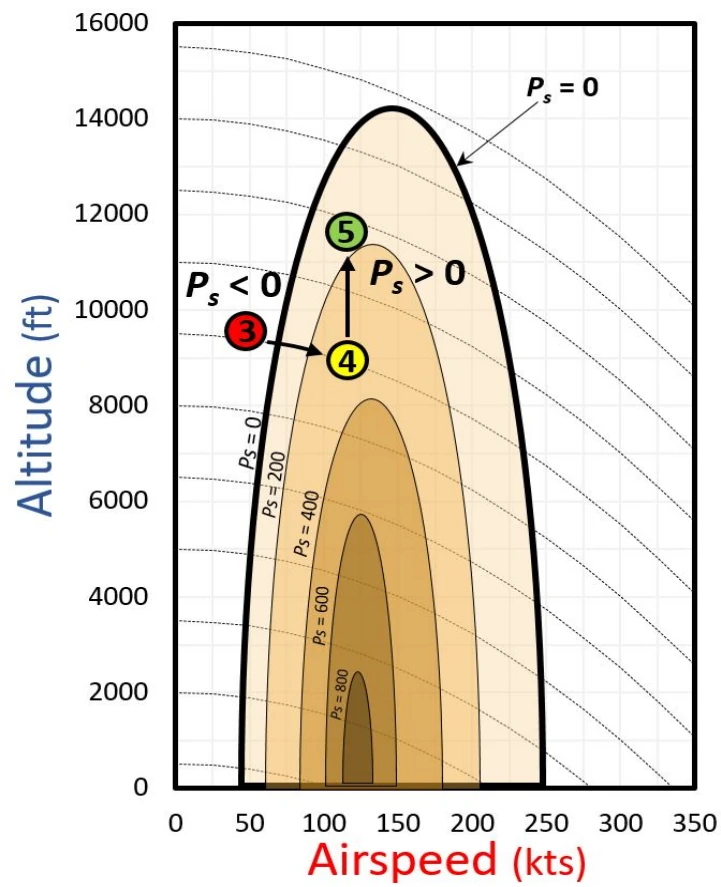
The above rising terrain scenario is just one example illustrating the risk of irreversible deceleration and/or sink rate. Pilots need to be aware that unintentional depletion of mechanical energy can happen in various instances, especially as the airplane approaches the slow edge of its energy envelope at low altitude, where available specific excess power (PS) is zero. Examples include unstable/ slow approaches to landing; high-drag go-arounds where the pilot neglects to raise the gear and/or flaps; and steeper-than-normal turns in the traffic pattern. Note that irreversible sink rates do not necessarily involve exceeding the critical AOA resulting in a stall and spin. The airplane can be unstalled and still experience unrecoverable sink rates near the high-speed edge of its energy envelope, where available specific excess power (PS) is also zero. Two examples are high-speed steep spirals following botched steep level turns, and high-speed dives too close to the ground.
The bottom line? Should the airplane ever experience unintended excessive negative energy rates with little or no excess power available under a given flight condition, the pilot needs to use proper energy management allowing a prompt recovery and a suitable follow-up action.
Review of Terms and Definitions
The terms and definitions specific to this chapter appear below.
Aircraft Energy Management
The process of planning, monitoring and controlling altitude and airspeed targets in relation to the airplane’s energy state. Note that this definition is concerned with managing mechanical energy (altitude and airspeed) and addresses the safety (flight control) side of energy management. It does not address the efficiency (aircraft performance) side of energy management, which is concerned with how efficiently the engine generates mechanical energy from fuel and how efficiently the airframe spends that energy in flight.
Energy System
A flying airplane is an open energy system. That means that the airplane can gain energy from some source (e.g., fuel) and lose energy to the environment (e.g., surrounding air). In addition, energy can be added to or removed from the airplane’s total mechanical energy stored as altitude and airspeed.
Total Mechanical Energy
Sum of the energy in altitude (potential energy) and the energy in airspeed (kinetic energy).
Kinetic Energy
Amount of energy due to the airspeed, expressed as ½mV², where m = airplane’s mass, and V = airspeed.
Potential Energy
Amount of energy due to the altitude, expressed as mgh, where m = airplane’s mass, g = gravitational constant, and h = altitude.
Energy State
The airplane’s total mechanical energy and its distribution between altitude and airspeed.
Energy Exchange
Trading one form of energy (e.g., altitude) for another form (e.g., airspeed).