
Chapter 4
Energy Management: Mastering Altitude and Airspeed Control
Note that in the scenario depicted in B in Figure 4-13, advancing the throttle forward to increase energy would only succeed if excess thrust is available (PS > 0). This may not be the case if the pilot has badly mismanaged energy and slowed down to a speed where induced drag is so high that even applying full throttle would result in no surplus energy (see column "Cautions When Very Slow" in Figure 4-12). Depending on the flight condition, available excess power at full throttle may be negative (PS < 0). In this case, the only recourse is to first trade altitude for speed by pushing forward on the yoke/stick, reducing AOA and induced drag, and only then advancing the throttle forward to regain total energy. But if the airplane is too close to the ground, there may not be enough room to reverse the negative energy rate and prevent the airplane from striking the ground.
Now consider the scenario depicted in C in Figure 4-13, where the airplane has descended below the desired flight path but is flying at the correct speed. Here, even though there is no speed deviation, the pilot is faced with a combination of total energy and distribution errors. Regaining altitude without changing speed requires advancing the throttle forward while easing aft on the yoke/ stick (6 in Figure 4-12). In other words, decoupling altitude and airspeed (i.e. changing one without changing the other) demands the use of both controls simultaneously.
In all cases, path and speed should be monitored carefully as they are corrected, adjusting pitch attitude and throttle setting as appropriate. Once short-term deviations are corrected, the airplane will need to be trimmed for long-term control to maintain the desired path-speed profile (5 in Figure 4-12).
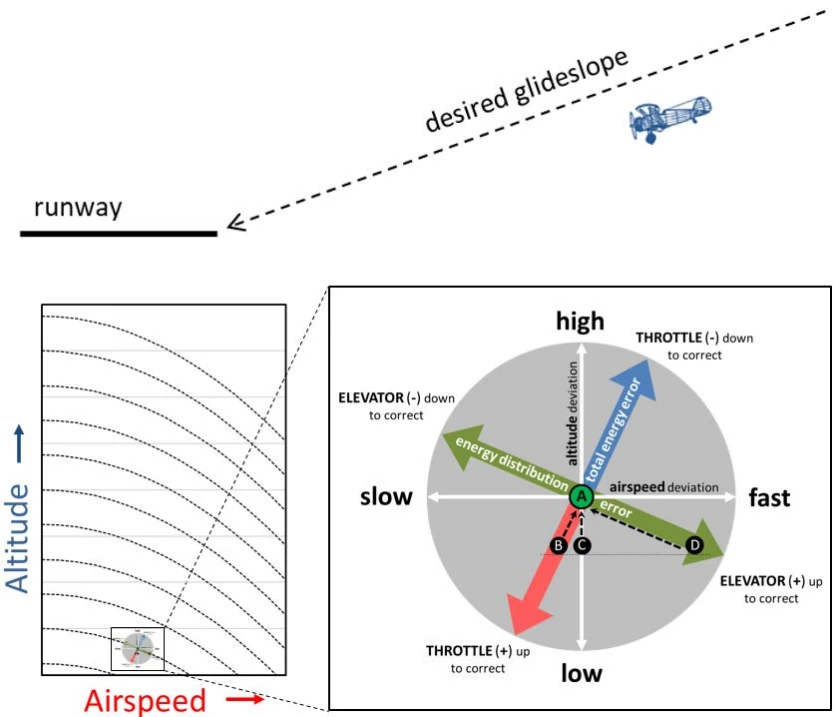
The above approach-to-landing scenario is just one example illustrating the risk of mismanaging altitude-speed deviations. Pilots need to be able to identify, assess, and mitigate altitude and/or airspeed deviations during any phase of flight, including traffic pattern operations, take-offs and climbs, cruise flight, descending flight, and any procedure or maneuver involving turns.
Clearly, skills for promptly correcting path-speed deviations can enhance flight safety but the pilot should also be aware of the risk of unrecoverable depletion of the airplane’s mechanical energy, especially as the airplane approaches the edges of its flight envelope where available excess power is zero.
Preventing Irreversible Deceleration and/or Sink Rate
During normal flight, the airplane experiences many instances of negative energy rates (negative specific excess power or PS < 0) while decelerating at a constant altitude or descending at a constant airspeed; these are intended energy bleed rates. However, one of the greatest dangers from mismanaging the airplane’s energy state is encountering unintended, excessive deceleration and/or sink rate coupled with little or no positive excess power available under a given flight condition. Failure to recover above a certain critical altitude results in depletion of mechanical energy. Regardless of what the pilot does past that point, the airplane will hit the ground.
To help pilots understand the risk of unintended energy depletion, let’s take a closer look at Scenario 2 [Figure 4-10]. This flight scenario illustrates a situation that is all too common in general aviation: flying toward rising terrain and not being able to fly up and over it before impacting terrain.
As shown in Figure 4-10, there is rising terrain all along the departure corridor. The scenario is as follows:
- A pilot of a normally-aspirated, twin-engine airplane departs out of Rocky Mountain Metropolitan airport (KBJC) in the morning on a nice summer day and flies into Aspen/Pitkin County airport (KASE).
- The pilot enjoys the scenery around Aspen, eats lunch, and decides to return home in the early hot afternoon.
- The pilot departs KASE off of runway 33. At full throttle/power the airplane takes longer to accelerate but rotates at the normal speed.
- The pilot pitches to the normal pitch target, retracts the gear, and initiates a climb.
- The pilot notices the airplane isn’t performing as desired. The pilot checks to see if the gear is up and adjusts the mixtures to try and get a little more power.
- The terrain is rising, the pilot gradually pitches up, and the airplane starts losing airspeed.
- The airplane quits climbing.
- The stall horn begins to sound.
The above scenario is hypothetical, but there have been very similar situations that have ended tragically.
The airplane in the above scenario has encountered an unintended deceleration and impending sink rate that could rapidly become irreversible. This can be shown in two ways, using the traditional power curve [Figure 4-14] and the energy map [Figure 4-15]:
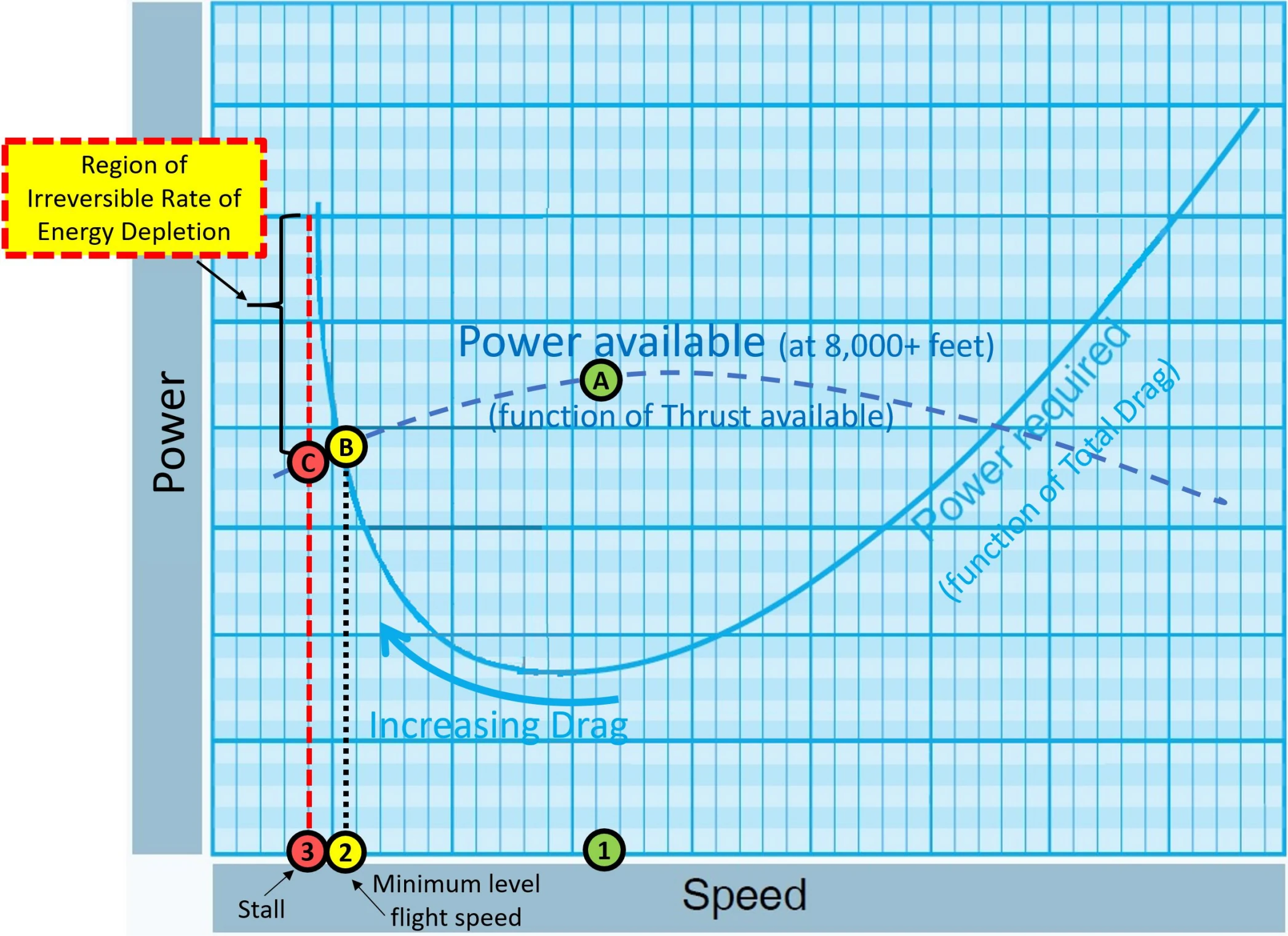
As illustrated in the airplane's power required and available curves [Figure 4-14], the airplane slows down, going from speed 1 where it is climbing (A: power available greater than power required), to speed 2, where it stops climbing (B: power available equal to power required), and continuing to speed 3 where the stall horn sounds (C: power available less than power required). The energy map [Figure 4-15] tells the same story from a total mechanical energy standpoint: the airplane has positive PS at point 1 and climbs to point 2 where it stops climbing since PS = 0, then continues to point 3, where the PS < 0 and the stall horn sounds.
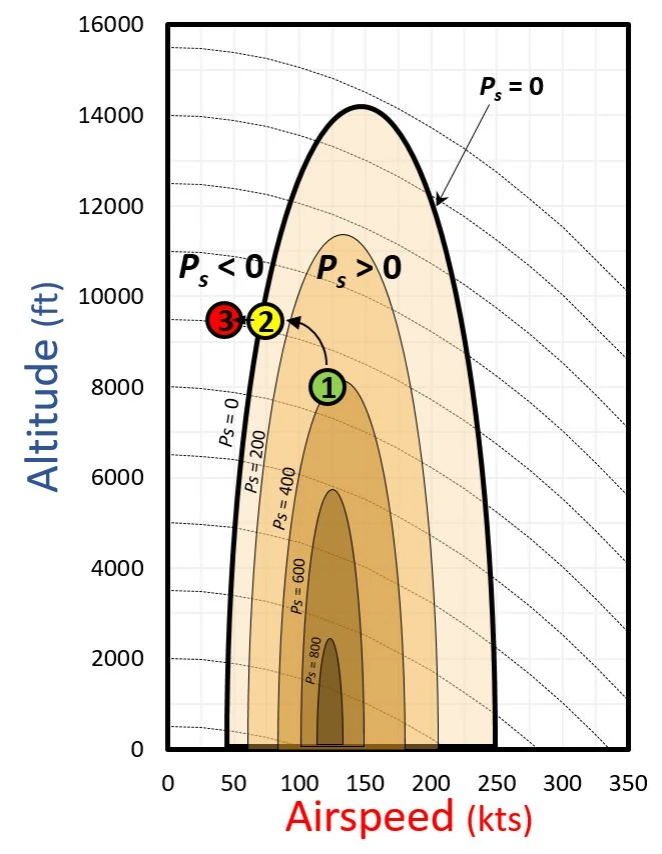
The question then is: what does the pilot do to recover from this predicament? The answer is proper energy management. The airplane needs to move to a different place on the energy map that will allow the airplane to begin climbing. So, what does that mean?
- As can be seen in Figure 4-12, the pilot is in a scenario akin to that at the desired altitude, but with cautions when very slow.
- The pilot then has to do something that is not intuitive; consider gaining speed at the expense of some altitude initially to improve climbing performance with full throttle.
- Once the airplane accelerates to an airspeed in which the PS > 0, it can begin to climb again.
The above recovery scenario is shown in the energy map Figure 4-16, which illustrates the important role of the elevator in assisting the pilot to recover from unintentional and dangerous deceleration and/or sink rate (refer to Additional Role for the Elevator section).
The airplane needs to gain speed at the expense of some altitude, moving from point 3 where the PS < 0 to point 4 where the PS > 0. The airplane can then initiate a constant airspeed climb to point 5, at the desired target altitude and airspeed [Figure 4-16]. Note that the desired target climb airspeed in the presence of rising terrain may be VX, the speed for best angle of climb. VX is slightly slower than VY, the speed for best rate of climb, and will result in a lower climb rate but steepest climb angle. Once the airplane has recovered from the unintentional airspeed loss and begins climbing at VX, the pilot should assess the situation and make an important decision to mitigate further risk—either continue climbing or do something else. Should the airplane not have the needed performance to safely clear the rising terrain on its intended course, the pilot has at least another available option: make a 180 degree turn and return to land at the departure airport until temperature and density altitude conditions improve.