Chapter 3
Basic Flight Maneuvers
Introduction
Airplanes operate in an environment that is unlike an automobile. Drivers tend to drive with a fairly narrow field of view and focus primarily on forward motion. Beginning pilots tend to practice the same. Flight instructors face the challenge of teaching beginning pilots about attitude awareness; which requires understanding the motions of flight. An airplane rotates in bank, pitch, and yaw while also moving horizontally, vertically, and laterally. The four fundamentals (straight-and-level flight, turns, climbs, and descents) are the principal maneuvers that control the airplane through the six motions of flight.
The Four Fundamentals
To master any subject, one should first master the fundamentals. For flying, this includes straight-and-level flight, turns, climbs, and descents. All flying tasks are based on these maneuvers, and an attempt to move on to advanced maneuvers prior to mastering the four fundamentals hinders the learning process.
Consider the following: a takeoff is a combination of a ground roll, which may transition to a brief period of straight-and-level flight, and a climb. After-departure includes the climb and turns toward the first navigation fix and is followed by straight-and-level flight. The preparation for landing at the destination may include combinations of descents, turns, and straight-and-level flight. In a typical general aviation (GA) airplane, the final approach ends with a transition from descent to straight-and-level while slowing for the touchdown and ground roll.
The flight instructor needs to impart competent knowledge of these basic flight maneuvers so that the beginning pilot is able to combine them at a performance level that at least meets the Federal Aviation Administration (FAA) Airman Certification Standards (ACS) or Practical Test Standards (PTS). As the beginning pilot progresses to more complex flight maneuvers, any deficiencies in the mastery of the four fundamentals are likely to become barriers to effective and efficient learning.
Effect and Use of Flight Controls
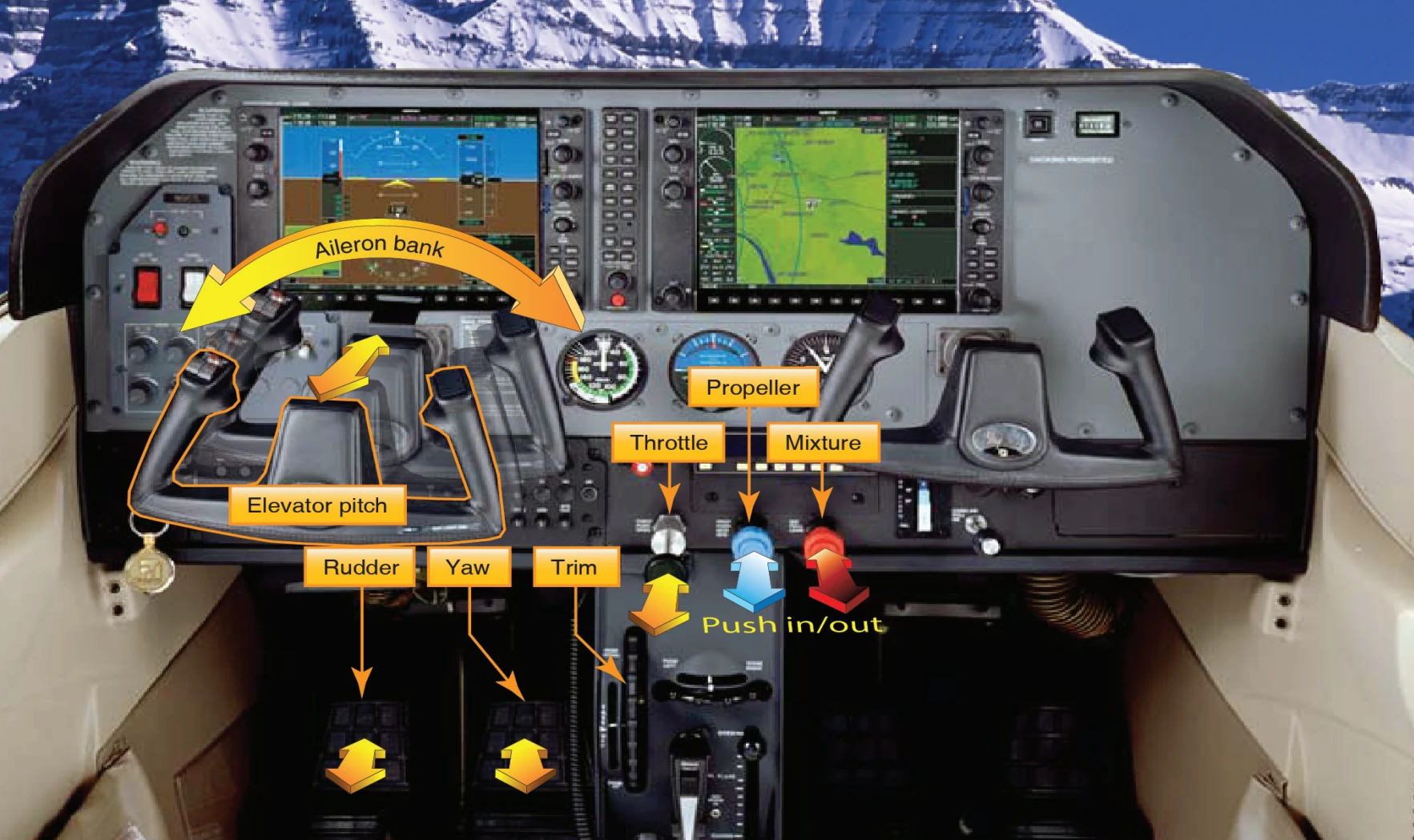
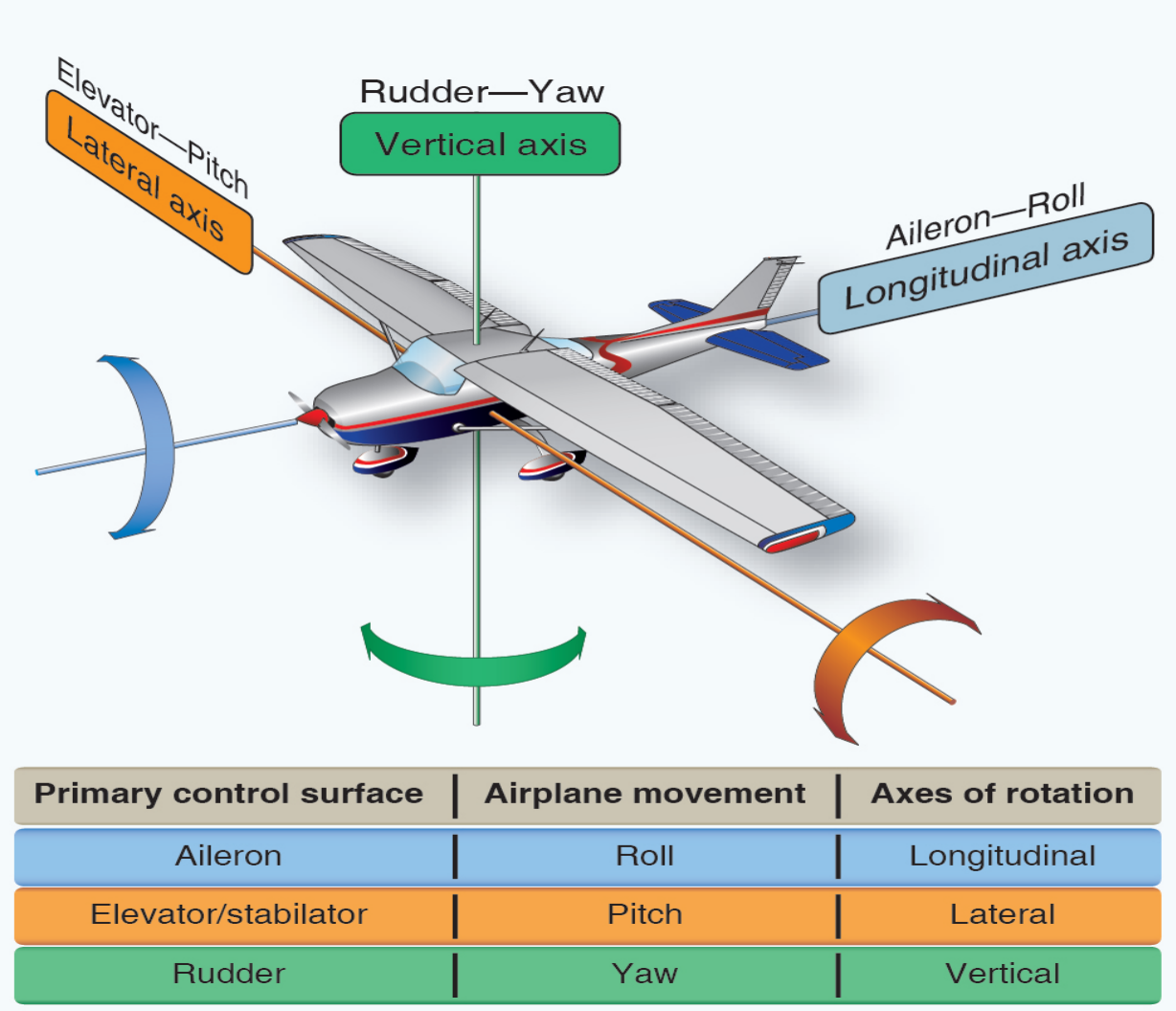
The airplane flies in an environment that allows it to travel up and down as well as left and right. Note that movement up or down depends on the flight conditions. If the airplane is right-side up relative to the horizon, forward control stick or wheel (elevator control) movement will result in a loss of altitude. If the same airplane is upside-down relative to the horizon that same forward control movement will result in a gain of altitude. [Figure 3-1] The following discussion considers the pilot's frame of reference with respect to the flight controls. [Figure 3-2]
With the pilot’s hand:
- When pulling the elevator pitch control toward the pilot, which is an aft movement of the control wheel, yoke, control stick, or side stick controller (referred to as adding back pressure), the airplane’s nose will rotate backwards relative to the pilot around the pitch (lateral) axis of the airplane. Think of this movement from the pilot’s feet to the pilot’s head.
- When pushing elevator pitch control toward the instrument panel, (referred to as increasing forward pressure), the airplane rotates the nose forward relative to the pilot around the pitch axis of the airplane. Think of this movement from the pilot’s head to the pilot’s feet.
- When right pressure is applied to the aileron control, which rotates the control wheel or yoke clockwise, or deflects the control stick or side stick to the right, the airplane’s right wing banks (rolls) lower in relation to the pilot. Think of this movement from the pilot’s head to the pilot’s right hip.
- When left pressure is applied to the aileron control, which rotates the control wheel or yoke counterclockwise, or deflects the control stick or side stick to the left, the airplane’s left wing banks (rolls) lower in relation to the pilot. Think of this movement from the pilot’s head to the pilot’s left hip.
With the pilot’s feet:
- When forward pressure is applied to the right rudder pedal, the airplane’s nose moves (yaws) to the right in relation to the pilot. Think of this movement from the pilot’s left shoulder to the pilot’s right shoulder.
- When forward pressure is applied to the left rudder pedal, the airplane’s nose moves (yaws) to the left in relation to the pilot. Think of this movement from the pilot’s right shoulder to the pilot’s left shoulder.
While in flight, the control surfaces remain in a fixed position as long as all forces acting upon them remain balanced. Resistance to movement increases as airspeed increases and decreases as airspeed decreases. Resistance also increases as the controls move away from a streamlined position. While maneuvering the airplane, it is not the amount of control surface displacement the pilot needs to consider, but rather the application of flight control pressures that give the desired result.
The pilot should hold the pitch and roll flight controls (aileron and elevator controls, yoke, stick, or side-stick control) lightly with the fingers and not grab or squeeze them with the entire hand. When flight control pressure is applied to change a control surface position, the pilot should exert pressure on the aileron and elevator controls with the fingers only. This is an important concept and habit to learn. A common error with beginning pilots is that they grab the aileron and elevator controls with a closed palm with such force that sensitive feeling is lost. Pilots may wish to consider this error at the onset of training as it prevents the development of “feel,” which is an important aspect of airplane control.
So that slight rudder pressure changes can be felt, both heels should support the weight of the pilot's feet on the floor with the ball of each foot touching the individual rudder pedals. The legs and feet should be relaxed. When using the rudder pedals, pressure should be applied smoothly and evenly by pressing with the ball of one foot. Since the rudder pedals are interconnected through springs or a direct mechanical linkage and act in opposite directions, when pressure is applied to one rudder pedal, foot pressure on the opposite rudder pedal should be relaxed proportionately.
In summary, during flight, the pressure the pilot exerts on the aileron and elevator controls and rudder pedals causes the airplane to move about the roll (longitudinal), pitch (lateral), and yaw (vertical) axes. When a control surface moves out of its streamlined position (even slightly), moving air exerts a force against that surface. It is this force that the pilot feels on the controls.
Feel of the Airplane
The ability to sense a flight condition, such as straight-and-level flight or a dive, without relying on instrumentation is often called “feeling the airplane.” Examples of this “feel” may be sounds of the airflow across the airframe, vibrations felt through the controls, engine and propeller sounds and vibrations at various flight attitudes, and the sensations felt by the pilot through physical accelerations.