
Chapter 3
Basic Flight Maneuvers
Humans sense “feel” through kinesthesis (the ability to sense movement through the body) and proprioception (unconscious perception of movement and spatial orientation). These stimuli are detected by nerves and by the semicircular canals of the inner ear. When properly developed, kinesthesis can provide the pilot with critical information about changes in the airplane’s direction and speed; however, there are limits in kinesthetic sense when relied upon solely without visual information, as when flying in instrument meteorological conditions (IMC). Sole reliance on the kinesthetic sense ultimately leads to disorientation and loss of aircraft control.
Developing this “feel” takes time and exposure in a particular airplane. It only comes with dedicated practice at the various flight conditions so that a pilot’s senses are trained by the sounds, vibrations, and forces produced by the airplane. The following are some important examples:
- Rushing air creates a distinctive noise pattern and as the level of sound increases, it likely indicates that the airplane’s airspeed is increasing and that the pitch attitude is decreasing. As the noise decreases, the airplane’s pitch attitude is likely increasing and its airspeed decreasing.
- The sound of the engine in cruise flight is different from that in a climb and different again when in a dive. In fixed-pitch propeller airplanes, when the airplane’s pitch attitude increases, the engine sound decreases and as pitch attitude decreases, the engine sound increases.
- In a banked turn, the pilot is forced downward into the seat due to the resultant load factor. The increased G force of a turn feels the same as the pull up from a dive, and the decreased G force from leveling out feels the same as lowering the nose out of a climb.
Sources of actual “feel” are very important to the pilot. This actual feel is the result of acceleration, which is simply how fast velocity is changing. Acceleration describes the rate of change in both the magnitude and the direction of velocity. These accelerations impart forces on the airplane and its occupants during flight. The pilot can sense vertical forces through pressure changes into the seat or horizontal forces while being pushed from side to side in the seat if the airplane slips or skids. These forces need not be strong, only perceptible by the pilot, to be useful. An accomplished pilot who has excellent “feel” for the airplane is able to detect even the smallest accelerations.
The flight instructor should teach the difference between perceiving and reacting to sound, vibrations, and forces versus merely noticing them. It is this increased understanding that contributes to developing a "feel" for the airplane. A pilot who develops a “feel” for the airplane early in flight training is likely to have less difficulty during more advanced training.
Attitude Flying
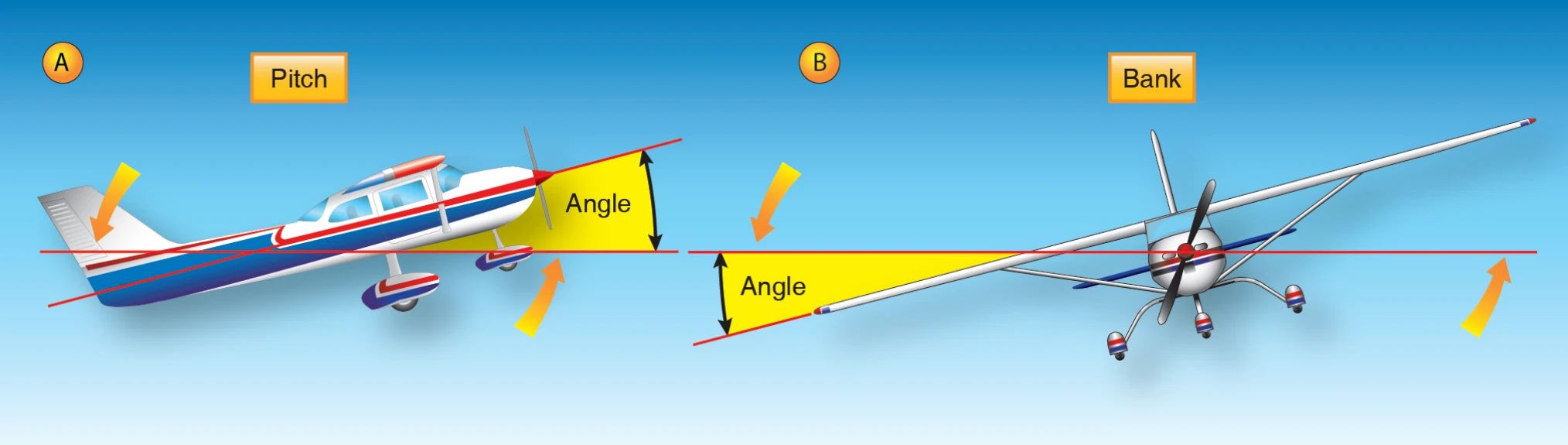
An airplane’s attitude is determined by the angular difference between a specific axis and the natural horizon. A false horizon can occur when the natural horizon is obscured or not readily apparent. This is an important concept because it requires the pilot to develop a pictorial sense of this natural horizon. Pitch attitude is the angle formed between the airplane’s longitudinal axis, which extends from the nose to the tail of the airplane, and the natural horizon. Bank attitude is the angle formed by the airplane’s lateral axis, which extends from wingtip to wingtip, and the natural horizon. [Figures 3-3A and 3-3B] Angular difference about the airplane’s vertical axis (yaw) is an attitude relative to the airplane’s direction of flight but not relative to the natural horizon.
Controlling an airplane requires one of two methods to determine the airplane’s attitude in reference to the horizon. When flying “visually” in visual meteorological conditions (VMC), a pilot uses their eyes and visually references the airplane’s wings and cowling to establish the airplane’s attitude to the natural horizon (a visible horizon). If no visible horizon can be seen due to clouds, whiteouts, haze over the ocean, night over a dark ocean, etc., it is IMC for practical and safety purposes. [Figure 3-4] When flying in IMC or when cross-checking the visual references, the airplane’s attitude is controlled by the pilot referencing the airplane’s mechanical or electronically-generated instruments to determine the airplane’s attitude in relation to the natural horizon.
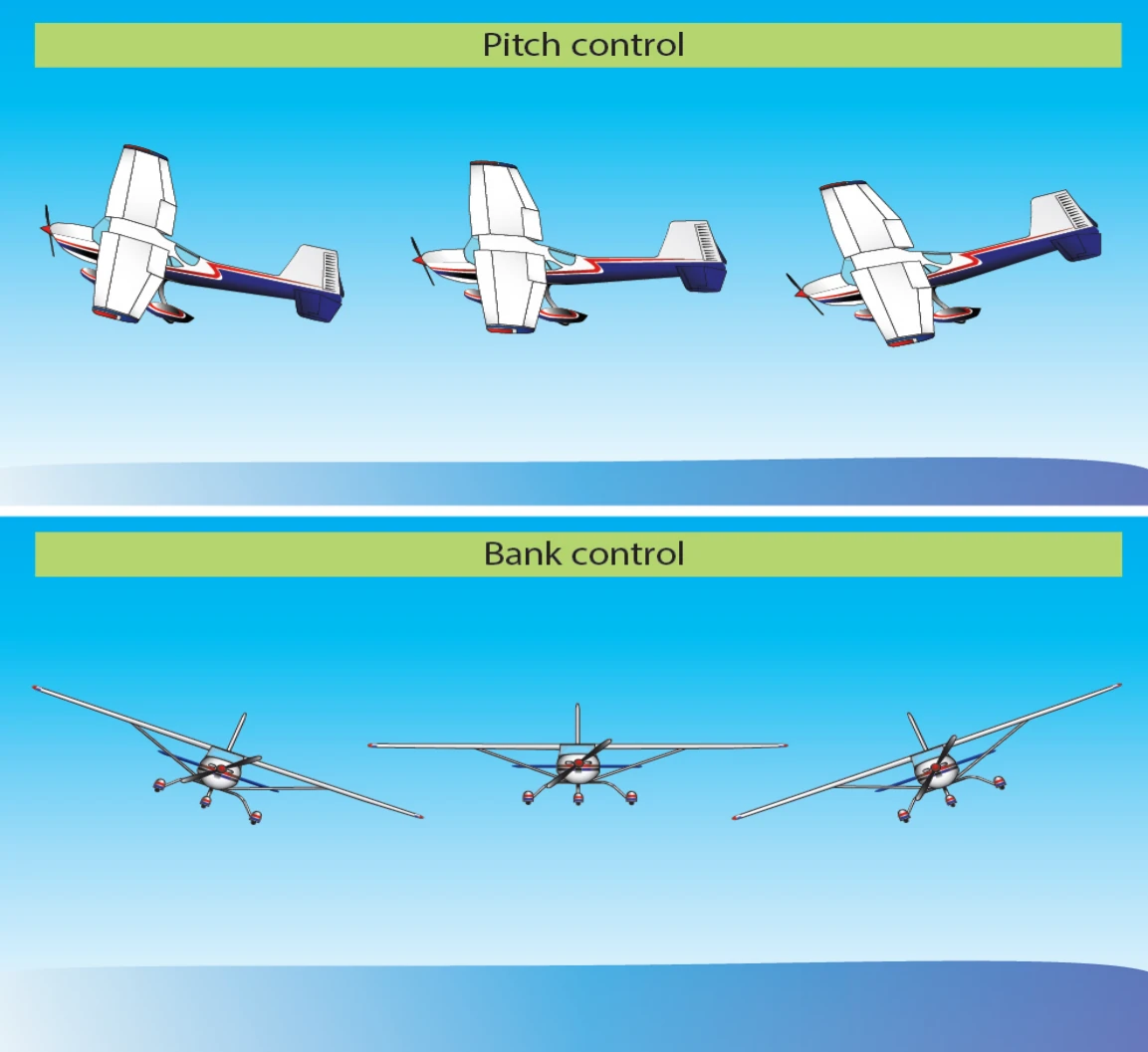
Airplane attitude control is composed of four components: pitch control, bank (roll) control, power control, and trim.
Pitch control—controlling of the airplane’s pitch attitude about the lateral axis by using the elevator to raise and lower the nose in relation to the natural horizon or to the airplane’s flight instrumentation.
Bank control—controlling of the airplane about the airplane’s longitudinal axis by use of the ailerons to attain a desired bank angle in relation to the natural horizon or to the airplane’s instrumentation.
Power control—controlled by the throttle in most general aviation (GA) airplanes and is used when the flight situation requires a specific thrust setting or for a change in thrust to meet a specific objective.
Trim control—used to relieve the control pressures held by the pilot on the flight controls after a desired attitude has been attained.
Integrated Flight Instruction
When introducing basic flight maneuvers to a beginning pilot, it is recommended that the “integrated” or “composite” method of flight instruction be used. This means the use of outside references and flight instruments to establish and maintain desired flight attitudes and airplane performance. When beginning pilots use this technique, they achieve a more precise and competent overall piloting ability. Although this method of airplane control may become second nature with experience, the beginning pilot needs to make a determined effort to master the technique. In all cases, a pilot’s visual skills need to be sufficiently developed for long-term, safe, and effective aircraft control. [Figure 3-5]
The basic elements of integrated flight instruction are as follows:
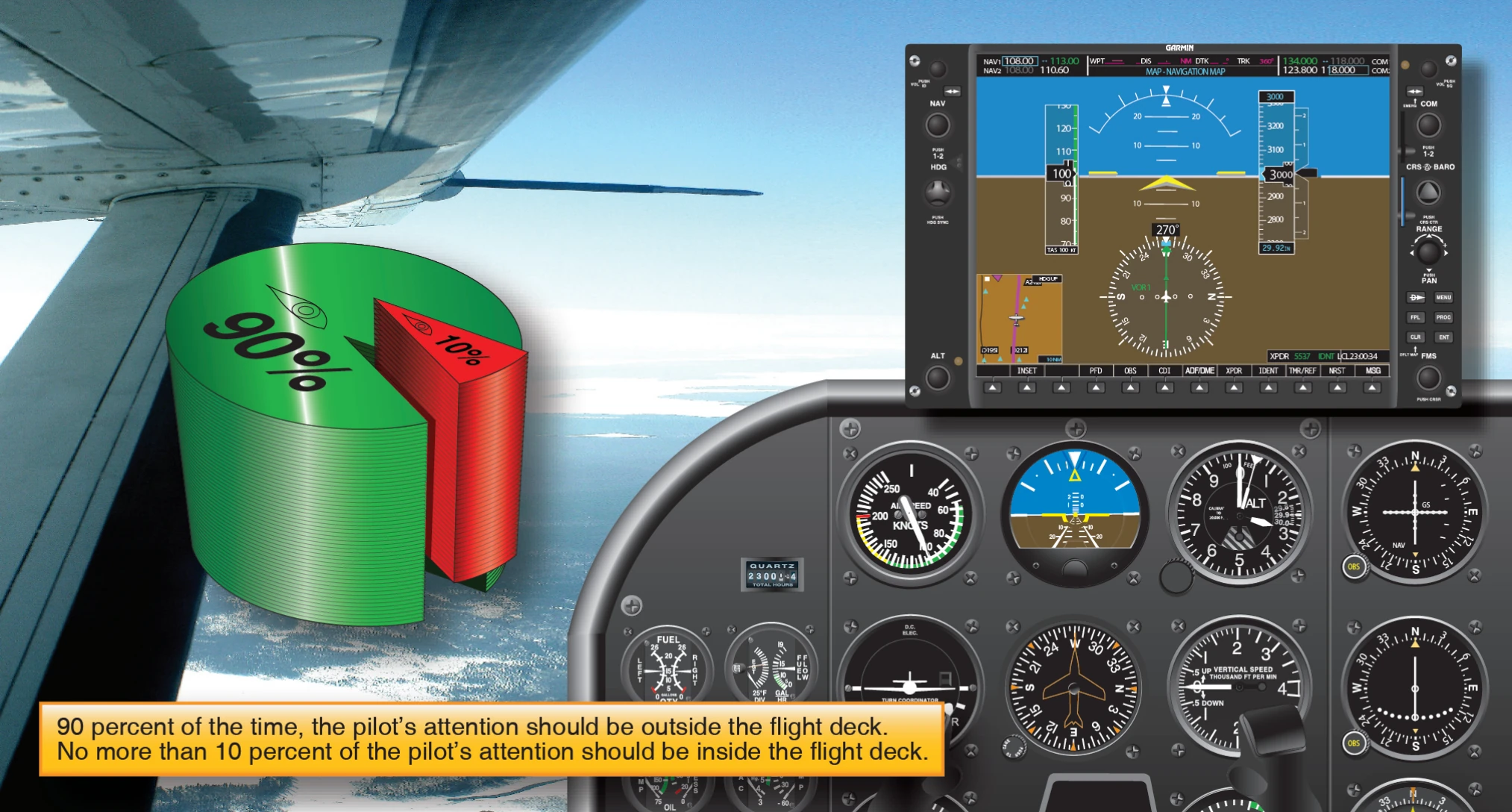
- The pilot visually controls the airplane’s attitude in reference outside to the natural horizon. Approximately 90 percent of the pilot’s attention should be devoted to outside visual references and scanning for airborne traffic. The process of visually evaluating pitch and bank attitude comes from a continuous stream of attitude information. When the pilot perceives that the attitude is other than desired, the pilot should make precise, smooth, and accurate flight control corrections to return the airplane to the desired attitude. Continuous visual checks of the outside references and immediate corrections made by the pilot minimize the chance for the airplane to deviate from the desired heading, altitude, and flightpath.
- The airplane’s attitude is validated by referring to flight instruments and confirming performance. If the flight instruments display that the airplane’s performance is in need of correction, the required correction needs to be determined and then precisely, smoothly, and accurately applied with reference to the natural horizon. The airplane’s attitude and performance are then rechecked by referring to flight instruments. The pilot then maintains the corrected attitude by reference to the natural horizon.
- The pilot should monitor the airplane’s performance by briefly checking the flight instruments. No more than about 10 percent of the pilot’s attention should be inside the flight deck. The pilot should develop the skill to quickly analyze the appropriate flight instruments and then immediately return to the visual outside references to control the airplane’s attitude.
The pilot should become familiar with the relationship between outside visual references to the natural horizon and the corresponding flight instrument indications. For example, a pitch attitude adjustment may require a movement of the pilot’s reference point of several inches in relation to the natural horizon but correspond to a seemingly insignificant movement of the reference bar on the airplane’s attitude indicator. Similarly, a deviation from a desired bank angle, which is obvious when referencing the airplane’s wingtips or cowling relative to the natural horizon, may be imperceptible on the airplane’s attitude indicator to the beginner pilot.
The most common error made by the beginner pilot is to make pitch or bank corrections while still looking inside. It is also common for beginner pilots to fixate on the flight instruments—a conscious effort is required by them to return to outside visual references. For the first several hours of instruction, flight instructors may choose to use flight instrument covers to develop a beginning pilot’s skill or to correct a pilot’s poor habit of fixating on instruments by forcing them to use outside visual references for aircraft control.