Chapter 3
Basic Flight Maneuvers
To return to straight-and-level flight from a climb, it is necessary to begin leveling-off prior to reaching the desired altitude. Level-off should begin at approximately 10 percent of the rate of climb. For example, if the airplane is climbing at 500 feet per minute (fpm), leveling off should begin 50 feet prior to reaching the desired altitude. The pitch attitude should be decreased smoothly and slowly to allow for the airspeed to increase. A loss of altitude may result if the pitch attitude is changed too rapidly without allowing the airspeed to increase proportionately.
After the airplane is established in level flight at a constant altitude, climb power should be retained temporarily so that the airplane accelerates to the cruise airspeed. When the airspeed reaches the desired cruise airspeed, the throttle setting and the propeller control, if equipped, should be set to the cruise power setting and the airplane re-trimmed.
Climbing Turns
In the performance of climbing turns, the following factors should be considered:
- With a constant power setting, the same pitch attitude and airspeed cannot be maintained in a bank as in a straight climb due to the increase in the total lift required. The airplane climbs at a slightly shallower climb angle because some of the lift is being used to turn the airplane.
- Steep bank angles significantly decreases the rate of climb. The pilot should establish and maintain an appropriate constant bank during the turn.
- The pilot should maintain a constant airspeed and constant rate of turn in both right and left turns. The coordination of all flight controls is a primary factor.
All the factors that affect the airplane during level constant-altitude turns affect the airplane during climbing turns. Compensation for the inherent stability of the airplane, overbanking tendencies, adverse yaw, propeller effects, reduction of the vertical component of lift, and increased drag needs to be managed by the pilot through the manipulation of the flight controls.
Climbing turns may be established by entering the climb first and then banking into the turn or climbing and turning simultaneously. During climbing turns, as in any turn, the loss of vertical lift should be compensated by an increase in pitch attitude. When a turn is coupled with a climb, the additional drag and reduction in the vertical component of lift need to be further compensated for by an additional increase in elevator back pressure. When turns are simultaneous with a climb, it is most effective to limit the turns to shallow bank angles. This provides for an efficient rate of climb. If a medium or steep banked turn is used, climb performance is degraded or possibly non-existent.
Common errors in the performance of climbs and climbing turns are:
- Attempting to establish climb pitch attitude by primarily referencing the airspeed indicator and chasing the airspeed.
- Applying elevator pressure too aggressively resulting in an excessive climb angle.
- Inadequate or inappropriate rudder pressure during climbing turns.
- Allowing the airplane to yaw during climbs usually due to inadequate right rudder pressure.
- Fixation on the airplane’s nose during straight climbs, resulting in climbing with one wing low.
- Initiating a climbing turn without coordinated use of flight controls, resulting in no turn and a climb with one wing low.
- Improper coordination resulting in a slip that counteracts the rate of climb, resulting in little or no altitude gain.
- Inability to keep pitch and bank attitude constant during climbing turns.
- Attempting to exceed the airplane’s climb capability. 10. Using excessive forward elevator pressure during level-off resulting in a loss of altitude or excessive low G-force.
Descents and Descending Turns
When an airplane enters a descent, its attitude changes from level flight to flight with a descent profile. [Figure 3-22] In a descent, weight no longer acts solely perpendicular to the flightpath. Since induced drag is decreased as lift is reduced in order to descend, excess thrust will provide higher airspeeds. The weight/gravity force is about the same. This causes an increase in total thrust and a power reduction is required to balance the forces if airspeed is to be maintained.
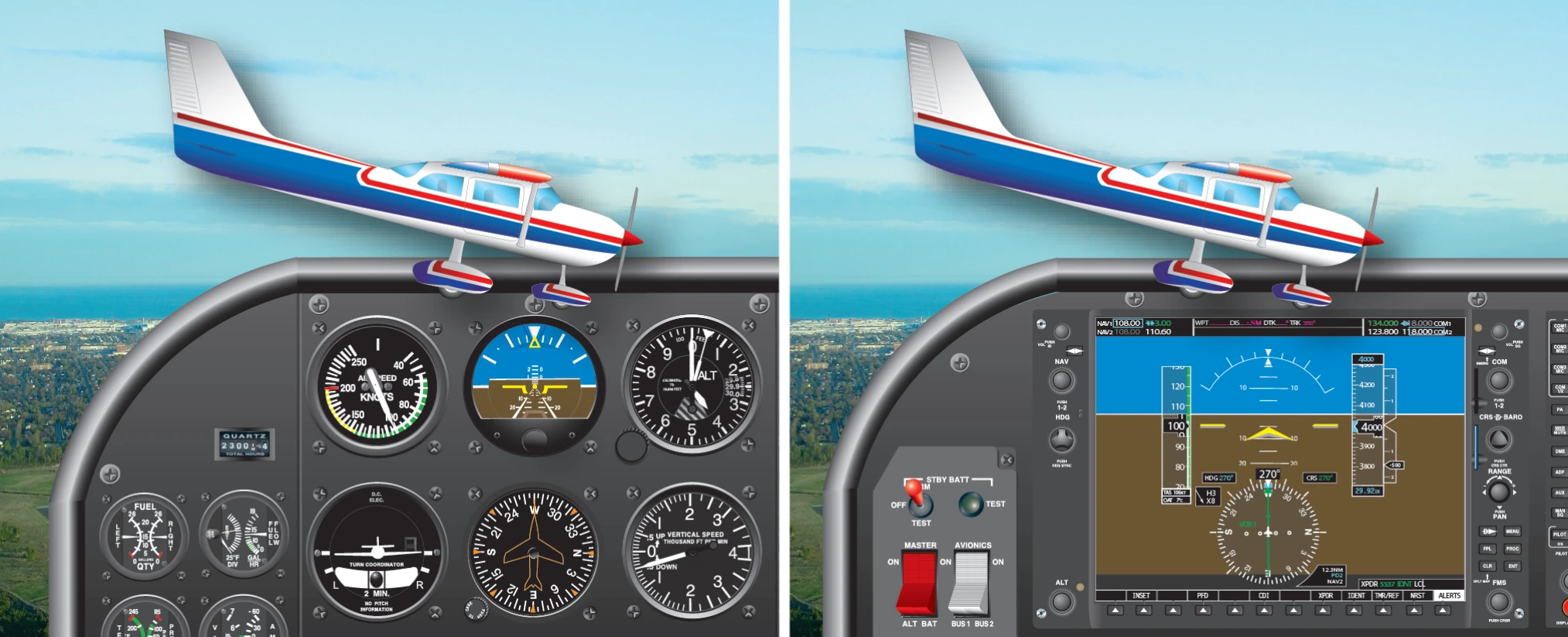
The pilot should know the engine power settings, natural horizon pitch attitudes, and flight instrument indications that produce the following types of descents:
- Partial power descent—the normal method of losing altitude is to descend with partial power. This is often termed cruise or en route descent. The airspeed and power setting recommended by the AFM/POH for prolonged descent should be used. The target descent rate should be 500 fpm. The desired airspeed, pitch attitude, and power combination should be preselected and kept constant.
- Descent at minimum safe airspeed—a nose-high, power-assisted descent condition principally used for clearing obstacles during a landing approach to a short runway. The airspeed used for this descent condition is recommended by the AFM/POH and is normally no greater than 1.3 VSO. Some characteristics of the minimum safe airspeed descent are a steeper-than-normal descent angle, and the excessive power that may be required to produce acceleration at low airspeed should “mushing” and/or an excessive rate of descent be allowed to develop.
- Emergency descent—some airplanes have a specific procedure for rapidly losing altitude. The AFM/POH specifies the procedure. In general, emergency descent procedures are high drag, high airspeed procedures requiring a specific airplane configuration (such as power to idle, propellers forward, landing gear extended, and flaps retracted), and a specific emergency descent airspeed. Emergency descent maneuvers often include turns.
Glides
A glide is a basic maneuver in which the airplane loses altitude in a controlled descent with little or no engine power. Forward motion is maintained by gravity pulling the airplane along an inclined path, and the descent rate is controlled by the pilot balancing the forces of gravity and lift. To level off from a partial power descent using a 1,000 feet per minute descent rate, the pilot should use 10 percent (100 feet in this example) as the distance above the desired level-off altitude to begin raising the nose and adding power to stop the descent and maintain airspeed.
Although glides are directly related to the practice of power-off accuracy landings, they have a specific operational purpose in normal landing approaches, and forced landings after engine failure. Therefore, it is necessary that they be performed more subconsciously than other maneuvers because most of the time during their execution, the pilot will be giving full attention to details other than the mechanics of performing the maneuver. Since glides are usually performed relatively close to the ground, accuracy of their execution and the formation of proper technique and habits are of special importance.
The glide ratio of an airplane is the distance the airplane travels in relation to the altitude it loses. For example, if an airplane travels 10,000 feet forward while descending 1,000 feet, its glide ratio is 10 to 1.
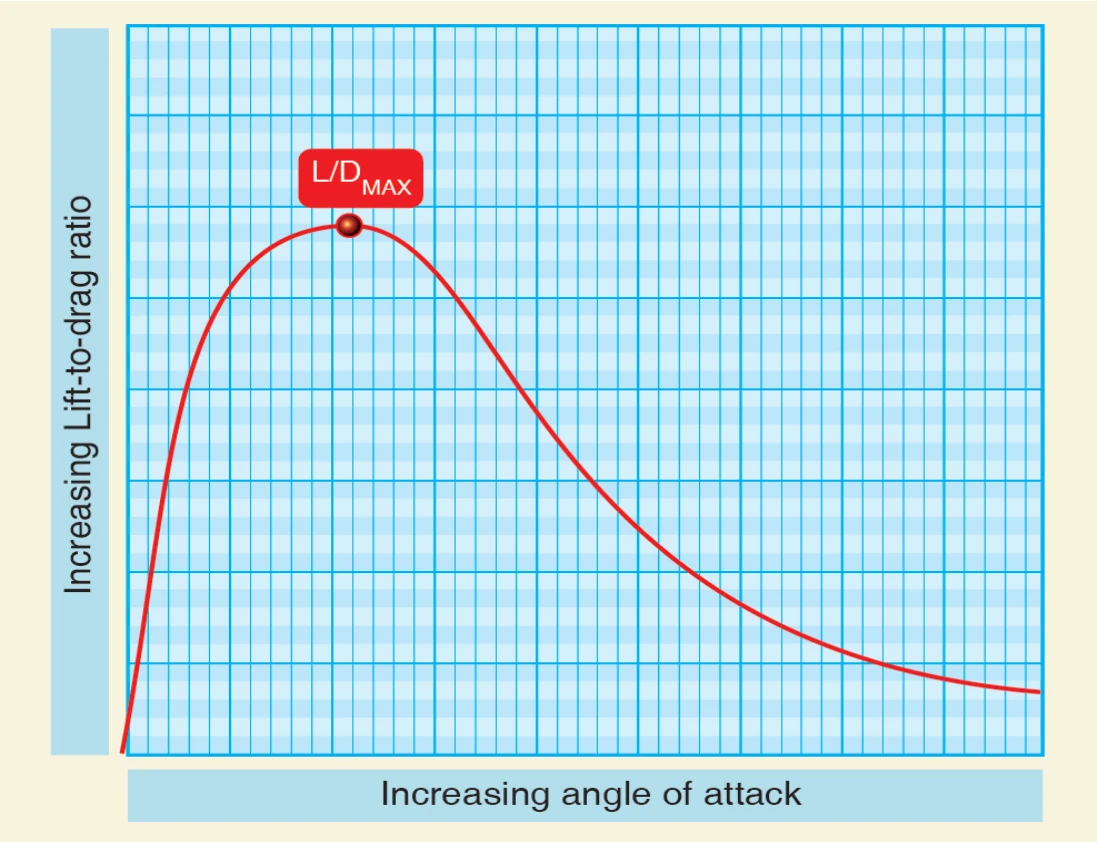
The best glide airspeed is used to maximize the distance flown. This airspeed is important when a pilot is attempting to fly during an engine failure. The best airspeed for gliding is one at which the airplane travels the greatest forward distance for a given loss of altitude in still air. This best glide airspeed occurs at the highest lift-to-drag ratio (L/D). [Figure 3-23] When gliding at airspeed above or below the best glide airspeed, drag increases. Any change in the gliding airspeed results in a proportional change in the distance flown. [Figure 3-24] As the glide airspeed is increased or decreased from the best glide airspeed, the glide ratio is lessened.