
Chapter 3
Basic Flight Maneuvers
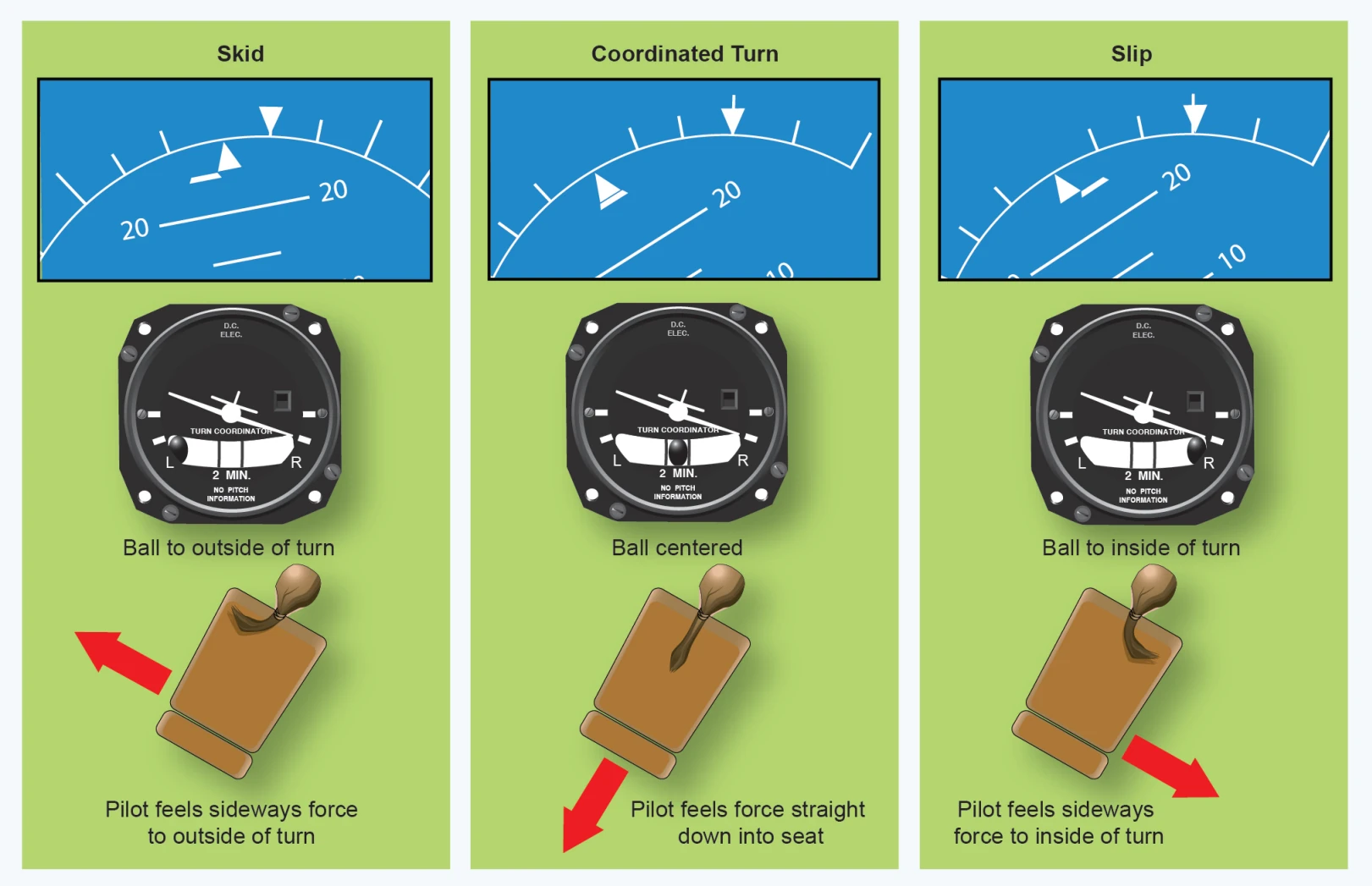
During uncoordinated flight, the pilot may feel that they are being pushed sideways toward the outside or inside of the turn. [Figure 3-13] The pilot feels pressed toward the outside of a turn during a skid and feels pressed toward the inside of a turn during a slip. The ability to sense a skid or slip is developed over time and as the “feel” of flying develops, a pilot should become highly sensitive to a slip or skid without undue reliance on the flight instruments.
Turn Radius
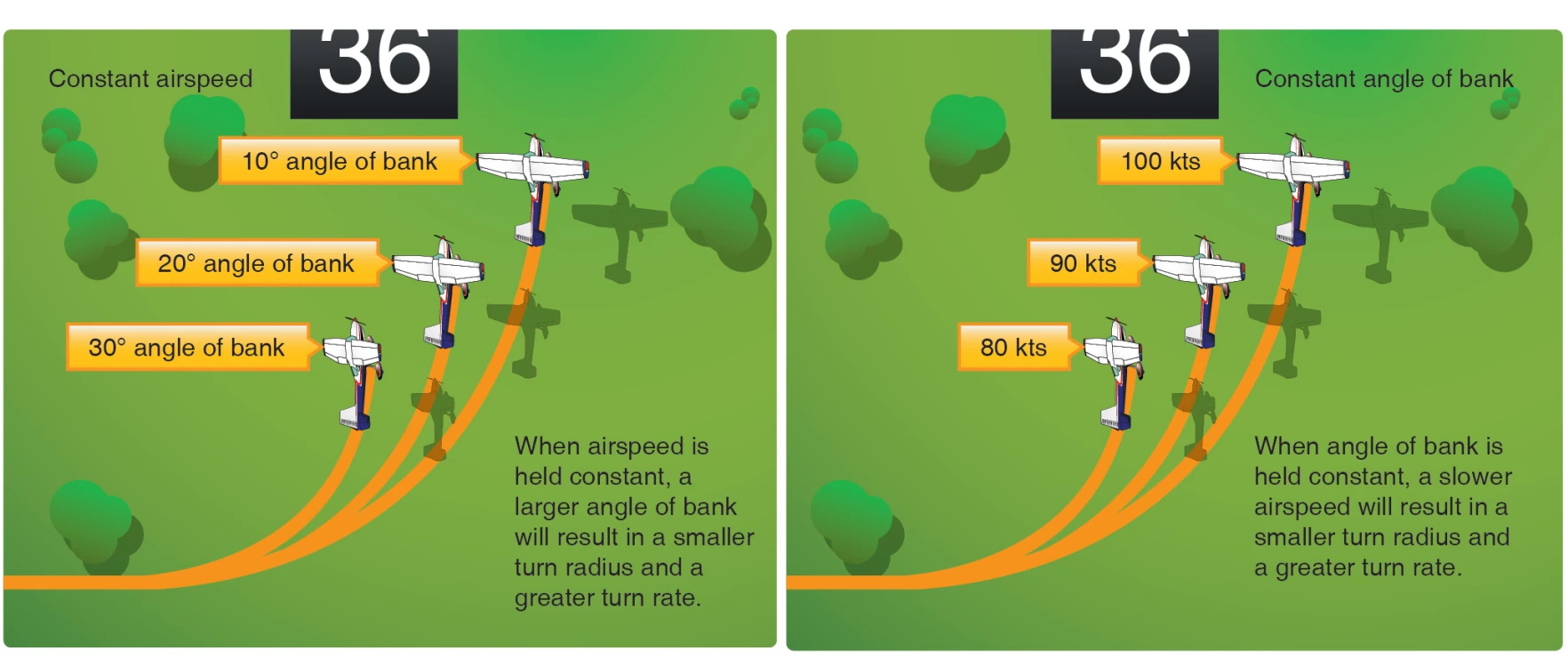
To understand the relationship between airspeed, bank, and radius of turn, it should be noted that the rate of turn at any given true airspeed depends on the horizontal lift component. The horizontal lift component varies in proportion to the amount of bank. Therefore, the rate of turn at a given airspeed increases as the angle of bank is increased. On the other hand, when a turn is made at a higher airspeed at a given bank angle, the inertia is greater and the horizontal lift component required for the turn is greater, causing the turning rate to become slower. [Figure 3-14] Therefore, at a given angle of bank, a higher airspeed makes the radius of turn larger because the airplane turns at a slower rate.
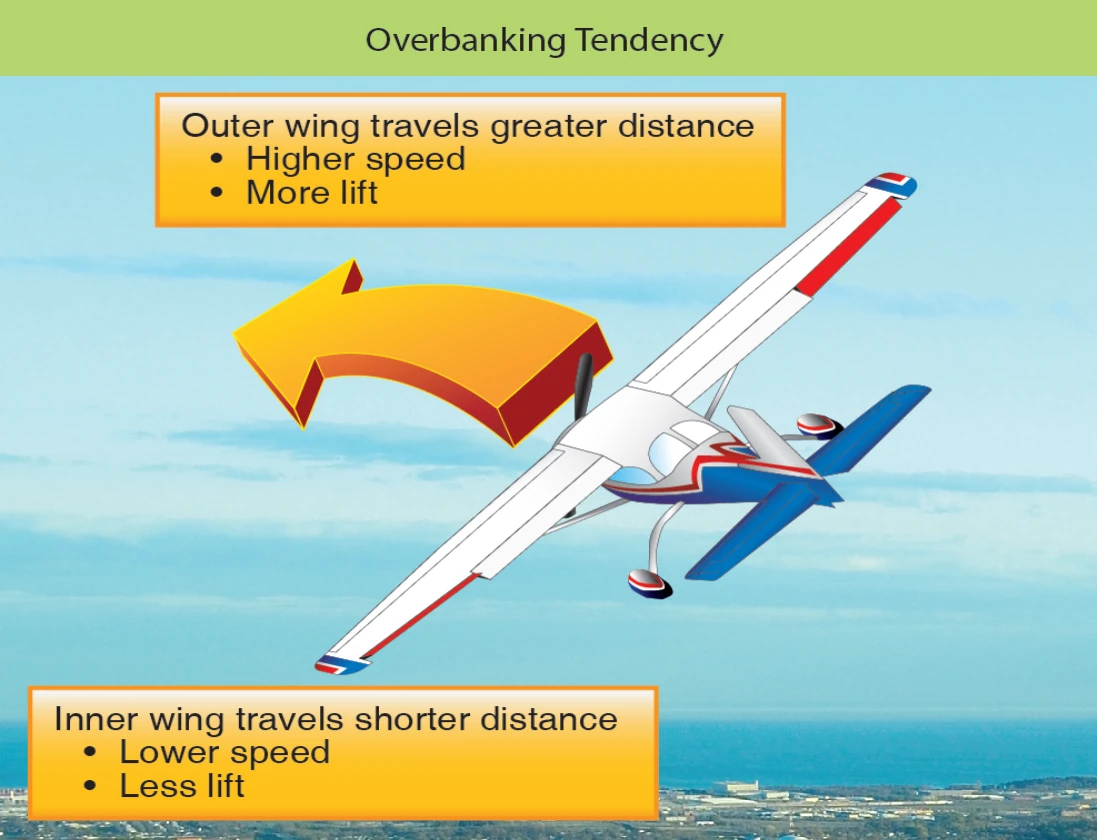
As the radius of the turn becomes smaller, a significant difference develops between the airspeed of the inside wing and the airspeed of the outside wing. The wing on the outside of the turn travels a longer path than the inside wing, yet both complete their respective paths in the same unit of time.
Therefore, the outside wing travels at a faster airspeed than the inside wing and, as a result, it develops more lift. This creates an overbanking tendency that needs to be controlled by the use of opposite aileron when the desired bank angle is reached. [Figure 3-15] Because the outboard wing is developing more lift, it also produces more drag. The drag causes a slight slip during steep turns that should be corrected by use of the rudder.
Establishing a Turn
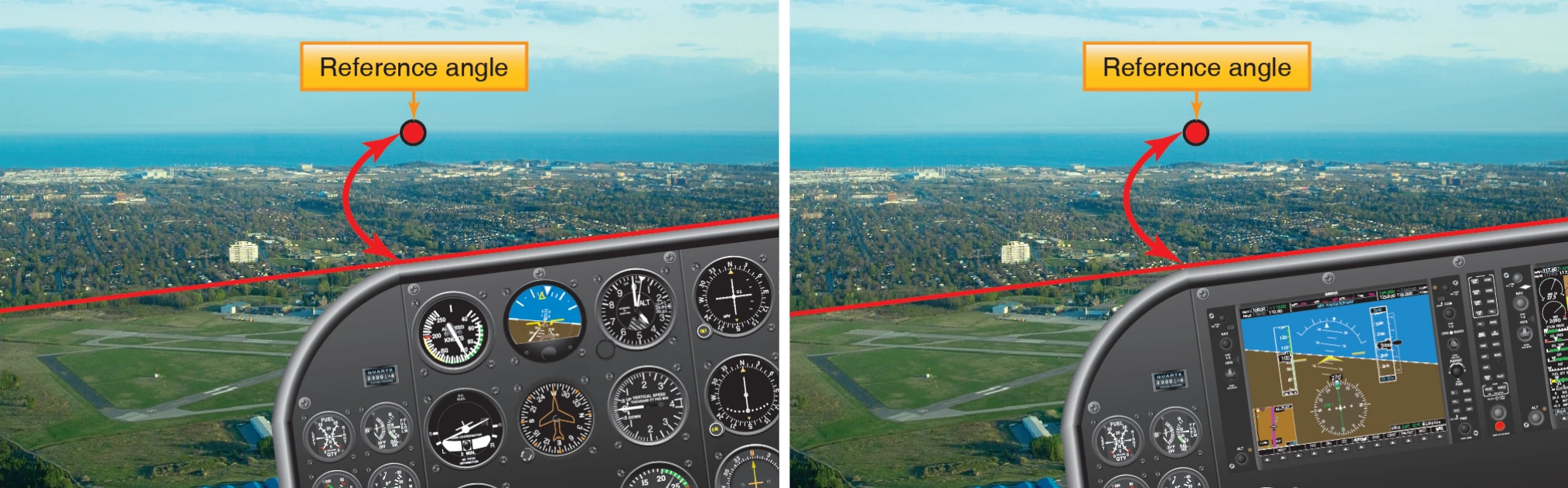
On most light single-engine airplanes, the top surface of the engine cowling is fairly flat, and its horizontal surface to the natural horizon provides a reasonable indication for initially setting the degree of bank angle. [Figure 3-16] The pilot should then cross- check the flight instruments to verify that the correct bank angle has been achieved. Information obtained from the attitude indicator shows the angle of the wing in relation to the horizon.
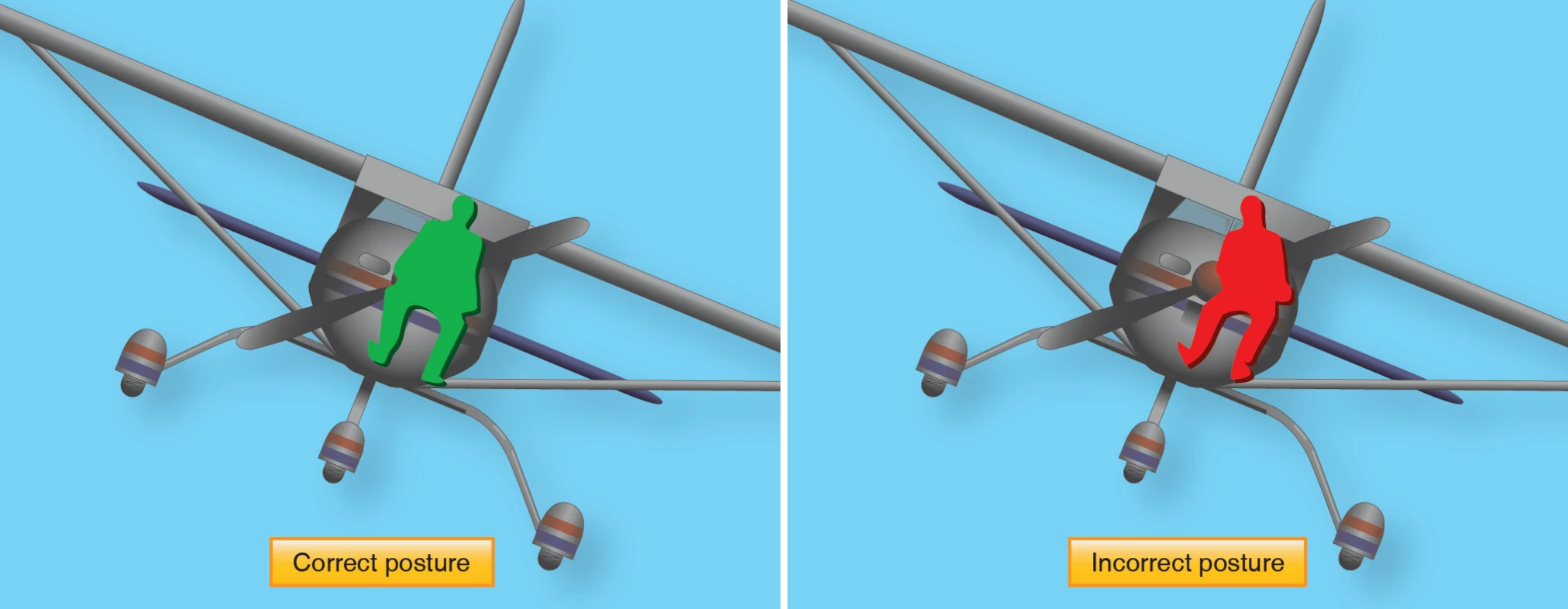
The pilot’s seating position in the airplane is important as it affects the interpretation of outside visual references. A common problem is that a pilot may lean away from the turn in an attempt to remain in an upright position in relation to the horizon. This should be corrected immediately if the pilot is to properly learn to use visual references. [Figure 3-17]
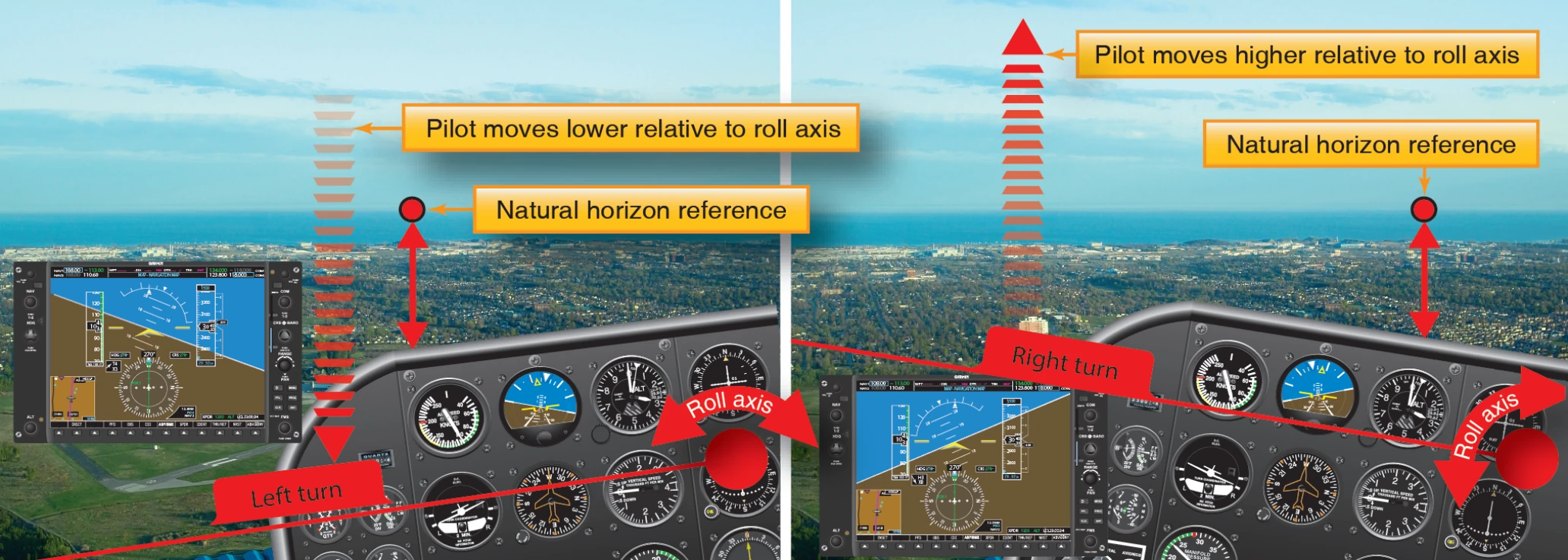
Because most airplanes have side-by-side seating, a pilot does not sit on the airplane’s longitudinal axis, which is where the airplane rotates in roll. The pilot sits slightly off to one side, typically the left, of the longitudinal axis. Due to parallax error, this makes the nose of the airplane appear to rise when making a left turn (due to pilot lowering in relation to the longitudinal axis) and the nose of the airplane appear to descend when making right turns (due to pilot elevating in relation to the longitudinal axis). [Figure 3-18]
Beginning pilots should not use large aileron and rudder control inputs. This is because large control inputs produce rapid roll rates and allow little time for the pilot to evaluate and make corrections. Smaller flight control inputs result in slower roll rates and provide for more time to accurately complete the necessary pitch and bank corrections.
Some additional considerations for initiating turns are the following:
- If the airplane’s nose starts to move before the bank starts, the rudder is being applied too soon.
- If the bank starts before the nose starts turning or the nose moves in the opposite direction, the rudder is being applied too late.
- If the nose moves up or down when entering a bank, excessive or insufficient elevator back pressure is being applied.
After the bank has been established, all flight control pressures applied to the ailerons and rudder may be relaxed or adjusted, depending on the established bank angle, to compensate for the airplane’s inherent stability or overbanking tendencies. The airplane should remain at the desired bank angle with the proper application of aileron pressure. If the desired bank angle is shallow, the pilot needs to maintain a small amount of aileron pressure into the direction of bank including rudder to compensate for yaw effects. For medium bank angles, the ailerons and rudder should be neutralized. Steep bank angles require opposite aileron and rudder to prevent the bank from steepening.
Back pressure on the elevator should not be relaxed as the vertical component of lift should be maintained if altitude is to be maintained. Throughout the turn, the pilot should reference the natural horizon, scan for aircraft traffic, and occasionally crosscheck the flight instruments to verify performance. A reduction in airspeed is the result of increased drag but is generally not significant for shallow bank angles. In steeper turns, additional power may be required to maintain airspeed. If altitude is not being maintained during the turn, the pitch attitude should be corrected in relation to the natural horizon and cross-checked with the flight instruments to verify performance.