
Chapter 2
Ground Operations
- Identifying personal attitudes hazardous to safe flight;
- Learning behavior modification techniques;
- Learning how to recognize and cope with stress;
- Developing risk assessment skills;
- Using all resources; and
- Evaluating the effectiveness of one’s own personal ADM skills.
Ground Operations
The airport ramp can be a complex environment with airport personnel, passengers, trucks, other vehicles, aircraft, and errant people and animals. The pilot is responsible for the operation of the airplane and should operate safely at all times. Ground operations subject the pilot to unique hazards, and mitigating those hazards requires proper planning and good situational awareness in the ground environment. A mitigation tactic involves reviewing the airport diagram prior to operating and having it readily available at all times. Whether departing to or from the ramp, the pilot needs to understand and capably manage the following:
- Refueling operations
- Passenger and baggage security and loading
- Ramp and taxi operations
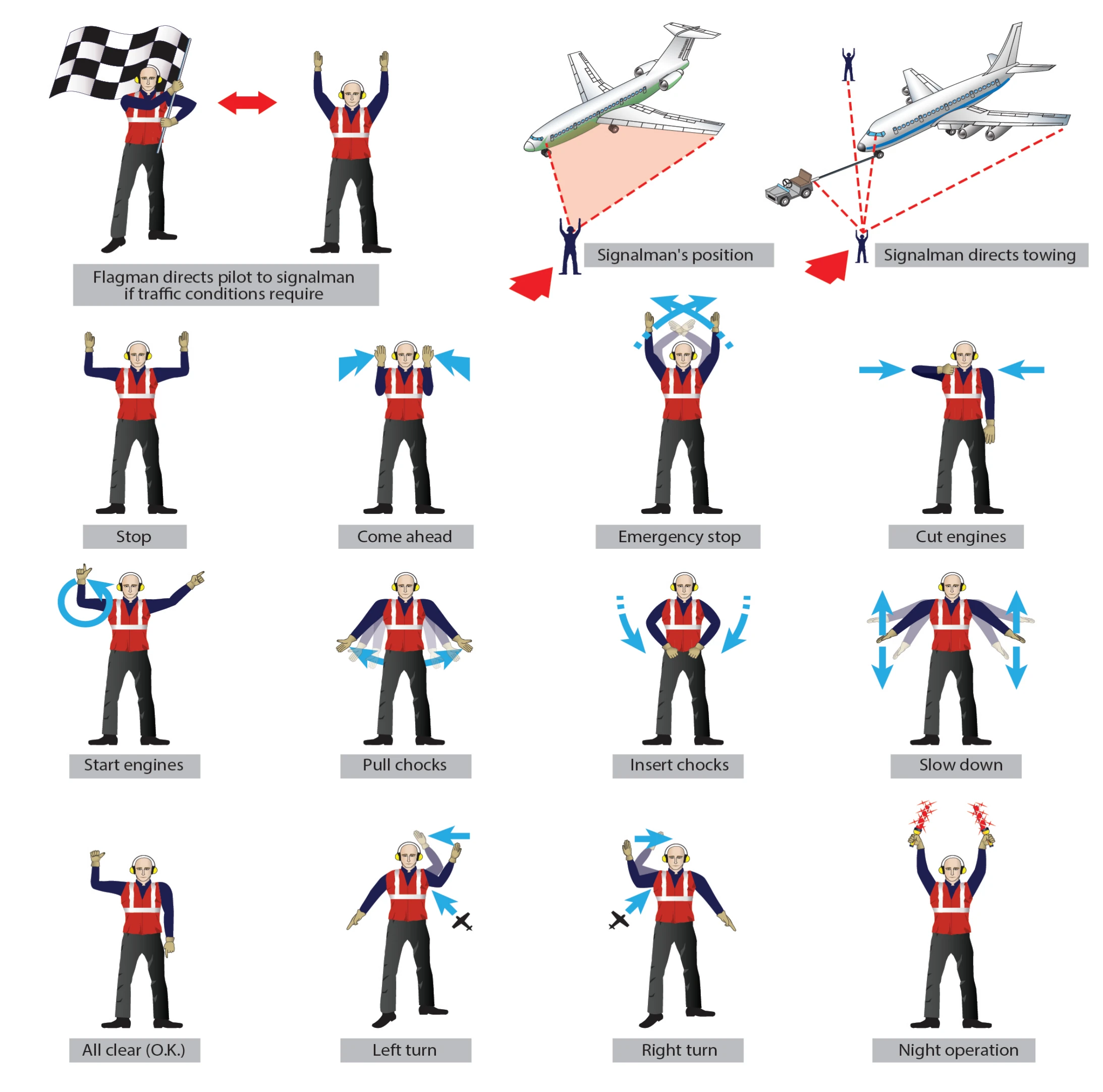
- Standard ramp signals
During refueling operations, it is advisable that the pilot remove all passengers from the aircraft and witness the refueling to ensure that the correct fuel and quantity is dispensed into the airplane and that any caps and cowls are properly secured after refueling.
Passengers may have little experience with the open ramp of an airport. The pilot should ensure the safety of the passengers by cautioning them to move on the surface only as directed. If not under the pilot's direct supervision, passengers should have an escort to ensure their safety and ramp security. Baggage loading and security should also be supervised by the pilot. Unsecured baggage or improperly loaded baggage may adversely affect the center of gravity of the aircraft.
Ramp traffic may vary from a deserted open space to a complex environment with heavy corporate or military aircraft. Powerful aircraft may produce exhaust blast or rotor downwash, for example, which could easily cause a light airplane to become uncontrollable. Mitigating these hazards in a light airplane is important to starting off on a safe flight.
Some ramps may be staffed by personnel to assist the pilot in managing a safe departure from the ramp to the taxiway. Figure 2-13 shows standard aircraft taxiing signals, such as those published in the Aeronautical Information Manual (AIM). There are other standard signals, such as those published in Advisory Circular 00-34, as revised, and by the Armed Forces. Furthermore, operation conditions in many areas may call for a modified set of taxi signals. The signals shown in Figure 2-13 represent a minimum number of the most commonly used signals. Whether this set of signals or a modified set is used is not the most important consideration, as long as each flight operational center uses a suitable, agreed-upon set of signals.
Engine Starting
Airplane engines vary substantially and specific procedures for engine starting should be accomplished in reference to the approved engine start checklist as detailed in the airplane’s AFM/POH. However, some generally accepted hazard mitigation practices and procedures are outlined in this section.
Prior to engine start, the pilot needs to ensure that the ramp area surrounding the airplane is clear of persons, equipment, and other hazards that could come into contact with the airplane or the propeller. Also, the pilot should check what is behind the airplane prior to engine start as standard practice. A propeller or other engine thrust can accelerate objects to substantial velocities, causing damage to property, and injuring those on the ground. The pilot should mitigate the hazard of debris being blown into persons or property. At all times before engine start, the anti-collision lights should be turned on. For night operations, the position (navigation) lights should also be on. Finally, just prior to starter engagement, the pilot should always call “CLEAR” out of the side window and wait for a response from anyone who may be nearby before engaging the starter.
When activating the starter, the wheel brakes need to be depressed and one hand kept on the throttle to manage the initial starting engine speed. Ensuring that properly operating brakes are engaged prior to starter engagement prevents the airplane from rapidly lunging forward. After engine start, the pilot manipulates the throttle to set the engine revolutions per minute (rpm) to the AFM/POH- prescribed setting. In general, 1,000 rpm is recommended following engine start to allow oil pressure to rise and to minimize undue engine wear due to insufficient lubrication at high rpm. It is important to service an airplane engine with the proper grade of oil for the seasonal conditions and to apply engine preheat when temperatures approach and descend below freezing.
The oil pressure should be monitored after engine start to ensure that pressure is increasing toward the AFM/POH-specified value. The AFM/POH specifies an oil pressure range for the engine. If the limits are not reached and maintained, serious internal engine damage is likely. In most conditions, oil pressure should rise to at least the lower limit within 30 seconds. To prevent damage, the engine should be shut down immediately if the oil pressure does not rise to the AFM/POH values within the required time.
Engine starters are electric motors designed to produce rapid rotation of the engine crankshaft for starting. These electric motors are not designed for continuous duty. Their service life may be drastically shortened during a prolonged or difficult start as an excess buildup of heat can damage internal starter components. Avoid continuous starter operation for periods longer than 30 seconds without a cool down period of at least 30 seconds to 1 minute (some AFM/POH specify longer cool down routines). The smell of burning insulation from a starter may indicate that the recommended cranking time has been exceeded. After repeated unsuccessful start attempts, the pilot should seek advice from a qualified person to determine the cause for the difficulty.
Although quite rare, the starter motor may remain electrically and mechanically engaged after engine start. This can be detected by a continuous and very high current draw on the ammeter. Some airplanes also have a starter engaged warning light specifically for this purpose. The engine should be shut down immediately if this occurs.
The pilot should be attentive for sounds, vibrations, smells, or smoke that are not consistent with normal after-start operational experience. Any concerns should lead to a shutdown and further investigation.
Hand Propping
The procedures for hand propping should always be in accordance with the AFM/POH and performed only by persons who are competent with hand propping procedures. The consequences of the hazards associated with hand propping are serious to fatal.
Historically, when aircraft lacked electrical systems, it was necessary for pilots and ground personnel to “hand prop” an aircraft for starting. Today, most airplanes are equipped with electric starters, and the starter should be working if the airplane is airworthy. If not, a certificated Aviation Maintenance Technician should be called to make a repair. However, vintage airplanes may be encountered, and an airplane manufactured without an electric starter needs to be hand propped. Since a number of these airplanes have been produced, the procedures for hand propping are described in this section.