
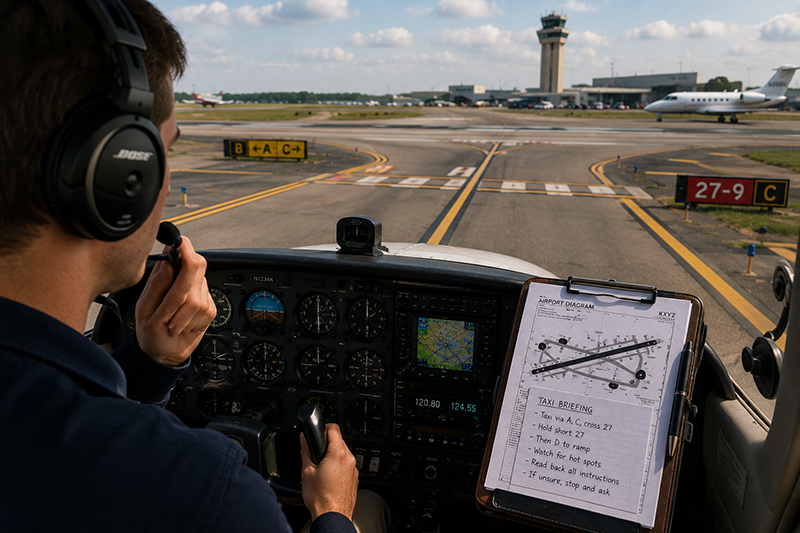
Radio communication confidence is one of the most practical skills a pilot can build, yet it is also one of the most common sources of stress during flight training. Many student pilots can fly the airplane with good control, navigate accurately, and understand the airspace, but still feel a spike of anxiety when it is time to press the push-to-talk switch. That reaction is normal. Aviation radio work combines language, timing, listening, aircraft control, airspace awareness, and decision-making, often while the airplane is moving quickly and the cockpit workload is changing.
The goal is not to sound impressive on the frequency. The goal is to communicate clearly enough that other pilots, air traffic control, and your own crew understand what you intend to do. Good radio technique supports safety, reduces confusion, and helps pilots stay ahead of the airplane. This article explains how pilots can improve radio confidence through preparation, phraseology, listening skills, cockpit organization, and realistic practice. It is written for student pilots, certificated pilots returning to busy airspace, instructors coaching nervous learners, and aviation professionals who want clearer communication habits.
What Radio Communication Confidence Really Means
Radio confidence is not the same thing as talking fast, using slang, or sounding like an airline crew. A confident aviation communicator is calm, brief, accurate, and adaptable. That pilot knows what information needs to be transmitted, listens before speaking, uses standard aviation language when appropriate, and asks for clarification when something is not understood.
In flight training, radio confidence often develops later than basic aircraft control. This makes sense. When a new pilot is learning to maintain altitude, manage airspeed, scan for traffic, interpret instruments, and navigate, radio communication competes for mental bandwidth. The microphone can feel like a public performance because every transmission is heard by others on the frequency. With practice, the radio becomes less of a performance and more of a tool.
A strong radio habit begins with a simple mental model: every call should answer a practical operational question. Who are you calling? Who are you? Where are you? What do you want or intend to do? What information have you received or understood? Not every radio call contains all of those elements, but most aviation communications fit into that structure. Once pilots understand the purpose behind the words, phraseology becomes easier to learn and easier to adapt.
Confidence also includes knowing when not to transmit. A pilot who listens first, waits for an appropriate break, and avoids blocking another transmission is demonstrating good radio judgment. Silence is not a weakness when the pilot is listening, planning, and choosing the right moment to speak. Radio discipline is part of airmanship.
Why This Matters in Real-World Aviation
Clear communication matters because aviation is a shared operating environment. At a nontowered airport, pilots use the radio to build a mental picture of other aircraft in the traffic pattern and nearby practice areas. In controlled airspace, pilots and controllers coordinate clearances, instructions, traffic advisories, runway assignments, altitude expectations, and route changes. In both environments, communication supports situational awareness.
A hesitant or disorganized radio call can create workload for everyone. A pilot who transmits without knowing the aircraft position, requested action, or assigned frequency may need repeated calls to resolve the same issue. That does not mean every transmission must be perfect. Even experienced pilots occasionally correct themselves. The real objective is to communicate the essential information in a way that others can act on.
Radio communication is also closely tied to cockpit resource management. Before a pilot can make a clear call, the pilot must manage priorities. Aircraft control comes first. If the airplane is not stabilized, the pilot should fly the airplane before trying to deliver a polished transmission. Once the aircraft is under control, the pilot can communicate. This is especially important during takeoff, landing, go-arounds, abnormal situations, high-density traffic, and weather diversions.
For instructors, radio confidence is more than a convenience. It is a training marker that shows whether a learner can integrate multiple tasks. A student who can anticipate the next call, listen for relevant traffic, and respond accurately is demonstrating improved situational awareness. A pilot who freezes on the radio may not simply have a communication problem. The hesitation may reveal task saturation, weak airspace knowledge, poor cockpit setup, or uncertainty about the next phase of flight.
For certificated pilots, radio proficiency can fade if most flying occurs from quiet airports or in familiar local areas. A pilot who is comfortable on a quiet common traffic advisory frequency may feel less confident when transitioning through Class C airspace, requesting flight following, or operating near a busy training airport. The solution is not avoidance. The solution is deliberate exposure, preparation, and practice under manageable conditions.
How Pilots Should Understand Aviation Radio Work
Aviation radio communication has three parts: listening, thinking, and speaking. Pilots often focus only on speaking, but the first two parts determine whether the transmission will be effective.
Listening comes first. Before transmitting, a pilot should identify the frequency, monitor ongoing traffic, and determine whether the frequency is busy. Listening helps the pilot avoid stepping on another transmission, recognize the rhythm of the airspace, and understand how other aircraft are reporting. At nontowered airports, listening may reveal runway in use, traffic pattern direction, aircraft positions, and whether any aircraft are practicing instrument approaches. With air traffic control, listening helps the pilot anticipate instructions, recognize similar call signs, and maintain awareness of traffic flow.
Thinking comes next. A good radio call is usually planned before the push-to-talk switch is pressed. The pilot should know the call sign, location, altitude if relevant, request or intention, and any required readback or acknowledgement. Writing down frequencies, clearances, taxi instructions, or route changes can reduce errors. Even a simple kneeboard note can make a major difference when workload increases.
Speaking is the last step. Speak at a normal pace, with the microphone close enough for clear audio but not so close that the transmission becomes distorted. Use plain aviation language and standard terms where appropriate. If a pilot makes a mistake, the correction should be simple and professional. There is no need to apologize at length or explain the mistake unless safety requires it. A corrected transmission is normal aviation communication.
One helpful principle is to think in message blocks. For example, an initial call to a tower might include the facility, aircraft identification, position, information code if applicable, and request. A traffic pattern call at a nontowered airport might include the airport name, aircraft identification, position in relation to the airport, altitude if useful, and intended runway or maneuver. A readback should include the important operational elements, such as runway assignment, hold short instruction, heading, altitude, or frequency, as applicable to the instruction received.
This block-based approach prevents memorized scripts from becoming a trap. Scripts are useful in early training, but real flying rarely follows a perfect script. Weather changes, controllers get busy, runway assignments shift, and other traffic may change the sequence. Pilots who understand the purpose of each message block can adapt without losing clarity.
The Role of Standard Phraseology
Standard phraseology gives pilots and controllers a shared language. It reduces ambiguity and shortens radio transmissions. Words such as “affirmative,” “negative,” “unable,” “stand by,” “wilco,” and “say again” have practical value because they communicate specific meanings in a concise way. A pilot does not need to sound theatrical or overly formal, but consistent terminology helps everyone understand the message faster.
One common training problem is that pilots try to memorize entire conversations instead of learning the building blocks. This can work during a lesson at a familiar airport, but it breaks down when the controller says something unexpected. A better approach is to practice common communication patterns while also learning what each part means. When the pilot understands the pattern, the words become flexible rather than fragile.
For example, a pilot requesting taxi should be ready with the aircraft identification, location on the airport, destination or direction of flight, and current weather information when appropriate for the operation. A pilot entering a traffic pattern at a nontowered airport should communicate position and intention in a way that helps other traffic visualize where the aircraft is and what it will do next. A pilot requesting flight following should be prepared with aircraft identification, type when useful, position, altitude, destination, and request.
Standard phraseology does not eliminate the need for plain language. When a situation is unusual, safety-related, or not easily described with standard terms, clear plain language is appropriate. The key is to be brief and specific. If you did not understand an instruction, say so. If you cannot comply, say “unable” and, when helpful, state the reason or offer an alternative. If you need time to manage the aircraft, say “stand by” when safe and appropriate. Clear honesty is better than pretending to understand.
Building Confidence Before the Flight
Radio confidence begins before engine start. A pilot who has reviewed the route, airspace, airport diagrams, frequencies, weather, expected runways, and likely communication points is already reducing cockpit workload. Preparation does not guarantee a perfect flight, but it gives the pilot a mental framework for what to expect.
Before a training flight, student pilots should brief the communication plan just as they brief the weather and aircraft. Which frequencies will be used? What radio calls are expected before taxi, before takeoff, in the practice area, returning to the airport, and entering the pattern? What is the plan if the frequency is congested? What will the student say if unsure of an instruction? These questions turn radio work into a teachable skill instead of a surprise event.
Instructors can help by previewing radio tasks rather than taking over too quickly. A student who is always rescued by the instructor may learn that radio work is dangerous or embarrassing. A more effective strategy is to brief the call, let the student make it, and debrief afterward. If safety or operational necessity requires the instructor to take over, the instructor can still explain why and then return the task to the student when workload permits.
For pilots flying to an unfamiliar airport, preparation should include reviewing the airport layout, runway lengths and orientations, traffic pattern information, available services, terrain, nearby airspace, and published communications data. If the airport is towered, review expected arrival and ground movement considerations. If it is nontowered, review traffic pattern procedures and nearby frequencies. This preparation gives the pilot the confidence to make position reports and requests without searching for basic information at the last moment.
Managing Microphone Anxiety
Microphone anxiety is real. It can affect capable pilots who understand the aircraft and the procedure but hesitate because they fear sounding unprofessional. The first step is to reframe the problem. The frequency is not a stage. It is a work channel. Other pilots are usually focused on flying their own aircraft, not judging your wording.
Many pilots reduce anxiety by rehearsing out loud before transmitting. Quietly saying the call once in the cockpit, or even forming it mentally, helps organize the message. In early training, writing a short template can help: “Who I’m calling, who I am, where I am, what I want.” Over time, the template becomes automatic.
Another useful technique is to slow down. Nervous pilots often speak too quickly, which increases the chance of stumbling and makes the call harder to understand. A normal conversational pace is usually more effective. If the frequency is busy, brevity matters, but speed is not the same as brevity. A short, clear message spoken at a reasonable pace is better than a rushed message that must be repeated.
Confidence also improves when pilots accept that corrections are part of flying. If you miss a call, ask for it again. If you read back the wrong runway or altitude and are corrected, fix it and continue. If you step on another transmission, wait and try again. Professional radio work is not error-free. It is disciplined, corrective, and safety-focused.
Common Mistakes or Misunderstandings
One common mistake is transmitting before listening. A pilot who changes frequency and immediately keys the microphone may block an existing exchange. Listening for a moment before transmitting is a simple habit that improves professionalism and reduces congestion.
Another mistake is using a memorized script without understanding the operational purpose. Scripts are helpful training wheels, but they should not become rigid. If a pilot only knows one exact wording pattern, an unexpected response can cause confusion. Pilots should understand what information is needed and why it matters.
A third mistake is giving too much information. Long transmissions can clutter the frequency and make the important details harder to identify. At the same time, being too brief can omit information that others need. The balance is to include what is operationally useful and leave out what is not.
Pilots also sometimes confuse confidence with informality. Casual language, slang, or overly clever phrasing may sound relaxed, but it can reduce clarity. Aviation communication works best when it is plain, concise, and predictable. This is especially important when pilots and controllers may have different accents, different experience levels, or different workload pressures.
Another frequent issue is failure to ask for clarification. Some pilots worry that “say again” makes them sound inexperienced. In reality, asking for clarification is a safe and professional response when an instruction or advisory is not understood. Acting on a misunderstood instruction can create far more risk than requesting a repeat.
Call sign confusion is another area that deserves attention. Similar-sounding call signs, aircraft operating in the same practice area, or multiple aircraft from the same flight school can make radio monitoring challenging. Pilots should listen carefully for their full call sign and avoid responding to transmissions intended for another aircraft. If there is doubt, clarify before acting.
Finally, pilots may allow radio work to distract from aircraft control. This is particularly common in the traffic pattern, during instrument training, or while approaching busy airspace. If cockpit workload becomes high, the pilot should prioritize aircraft control and navigation, then communicate as workload allows. A late but clear call is usually better than a rushed call that compromises flying the aircraft.
Practical Example: Returning to a Busy Training Airport
Consider a student pilot returning from the practice area to a busy training airport on a clear afternoon. Several aircraft are in the pattern, another aircraft is departing, and one airplane is practicing an instrument approach. The student is comfortable flying the airplane but becomes nervous about making the initial call because the frequency is active.
A confident communication process begins before the call. The student levels the aircraft, confirms position, checks altitude, listens to the frequency, and builds a mental picture of traffic. The instructor asks, “What do they need to know?” The student answers: the airport being called, aircraft identification, position from the airport, altitude if useful, and intention to enter the pattern for landing.
The student waits for a break and transmits a concise position and intention report. Another aircraft reports downwind. The student hears that traffic and adjusts the mental picture. A few moments later, the student reports entering the appropriate leg of the traffic pattern when it is useful to other traffic. The call is not theatrical, and it is not perfect. But it is clear enough for other pilots to understand location and intention.
Now imagine the student misses part of a transmission from another aircraft. Instead of guessing, the student asks for clarification or continues scanning visually while maintaining safe spacing. The instructor may coach quietly, but the student remains responsible for flying the airplane first. After landing, the debrief is specific: what was clear, what could be shorter, what traffic information was useful, and how the student managed timing on a busy frequency.
This example illustrates an important point. Radio confidence is not a single skill. It is the integration of aircraft control, listening, position awareness, phraseology, timing, and judgment. Each flight is an opportunity to improve one part of that system.
Best Practices for Pilots
The best way to build radio confidence is through deliberate practice in realistic conditions. Reading phraseology examples is useful, but pilots improve faster when they practice speaking, listening, and responding in context. That can happen in the airplane, in a simulator, with an instructor, or even during chair-flying at home.
Chair-flying radio calls is especially valuable for student pilots. Sit with an airport diagram, a route plan, and the expected frequencies. Practice the calls for engine start, taxi, takeoff, departure, practice area work, return, pattern entry, landing, and taxi back. Say the calls out loud. If a call sounds awkward, refine it. The objective is not to memorize every word, but to develop comfort with the rhythm and structure.
Listening to aviation communications can also help, where legally and appropriately available. The goal is not to copy every phrase heard on a frequency, because not every real-world transmission is a model example. Instead, listen for patterns: how pilots identify themselves, how controllers issue instructions, how readbacks are structured, and how pilots ask for clarification. Focus on clarity and operational meaning.
During actual flights, use small goals. On one lesson, focus on making the initial call without rushing. On another, focus on accurate readbacks. On another, focus on building a traffic picture from radio reports. This prevents the student from feeling that every radio skill must be mastered at once.
Short written notes can also improve performance. Before a flight, write down the likely frequencies in order. During taxi or in cruise, jot down clearances or key instructions. In single-pilot operations, cockpit organization matters. A pilot fumbling for a frequency or trying to remember a complex instruction while maneuvering is more likely to make mistakes.
- Listen before transmitting, especially immediately after changing frequencies.
- Plan the message before pressing the push-to-talk switch.
- Use a normal pace and clear pronunciation rather than rushing.
- Read back important instructions accurately when a readback is expected.
- Ask for clarification when a transmission is unclear or incomplete.
- Keep flying the airplane as the first priority.
For instructors, one of the best practices is to teach radio work progressively. Early lessons may involve the instructor modeling calls while the student listens. Then the student can make simple calls from a prepared script. Later, the student can handle more complex communication with less prompting. Eventually, the instructor can introduce realistic distractions, busy frequencies, and unfamiliar airports while maintaining safe margins.
For experienced pilots, the best practice is to avoid complacency. If radio work has become casual, review current guidance, practice concise transmissions, and seek feedback from another pilot or instructor. If you have avoided certain airspace because of radio discomfort, consider flying with an instructor to regain proficiency in a structured environment.
Improving Readbacks and Acknowledgements
Readbacks are a major part of radio confidence because they confirm that the pilot heard and understood the instruction. A good readback is not a robotic repetition of every word. It is a clear acknowledgement of the operational elements that matter. Depending on the situation, that may include a runway, hold short instruction, heading, altitude, route, frequency, transponder code, or clearance limit.
When workload is high, readbacks can suffer. A pilot may hear the first part of an instruction but miss the second, or may read back what was expected instead of what was actually said. This is why disciplined listening is important. If a transmission contains several elements, write them down when practical. If you are unsure, ask for the instruction again before acting.
Pilots should also be careful with expectation bias. If you expected runway 27 but were assigned runway 22, your brain may try to “hear” the expected runway. Similar problems can occur with headings, altitudes, taxi routes, and frequencies. A clear readback gives the controller or other communicating party an opportunity to catch the error before it becomes an operational problem.
In nontowered operations, the concept is slightly different because pilots are not receiving ATC instructions on the traffic advisory frequency. Still, acknowledgements and position reports must be accurate enough to support situational awareness. If another aircraft reports a position that affects your plan, it may be appropriate to communicate your intention clearly and adjust spacing as needed.
Radio Confidence in Nontowered Operations
Nontowered airport communication requires both radio skill and visual discipline. A radio report does not replace see-and-avoid responsibilities, and not every aircraft in the area may be communicating on the frequency. Pilots should use radio calls as one source of information, not the only source.
Confidence at nontowered airports comes from understanding traffic pattern geometry and reporting useful positions. A vague call such as “in the area” provides little value. A clearer call gives other pilots a usable location and intention. For example, a pilot might report direction and distance from the airport, intended runway, and planned pattern entry when that information is relevant. In the pattern, calls such as downwind, base, and final help other pilots sequence and scan.
The airport name should be used at the beginning and often at the end of transmissions when appropriate, especially where nearby airports share the same frequency. This helps reduce confusion. Pilots should also be alert for similar runway numbers, overlapping practice areas, and aircraft using instrument procedures near the airport.
Good nontowered radio work is cooperative rather than controlling. Pilots announce, coordinate, listen, and adjust. The radio helps build a shared traffic picture, but each pilot remains responsible for safe operation of the aircraft.
Radio Confidence with Air Traffic Control
Working with air traffic control can feel intimidating for pilots who are new to controlled airspace, but the same fundamentals apply. Know who you are calling, identify yourself, state where you are, and make a clear request. Then listen carefully and respond to the instruction or clearance you receive.
Controllers are managing traffic and workload. A concise initial call helps them help you. If the frequency is busy, an initial call may be short. Once ATC responds, provide the requested details. If you need something specific, such as a transition, flight following, landing clearance, or assistance with a route change, state the request plainly.
Pilots should not guess at ATC instructions. If a clearance, heading, altitude, route, or frequency is unclear, ask for clarification. If you cannot comply because of aircraft performance, weather, traffic, terrain, or workload, communicate that clearly. “Unable” is a useful word when used appropriately and honestly.
ATC communication also requires anticipation. Before calling a new facility, have the frequency ready, know your position and altitude, and be prepared for possible instructions. When approaching an airport, listen to the automatic weather broadcast if available and note the information code. When taxiing, have the airport diagram available and be prepared to write down taxi instructions.
Training Techniques for Instructors and Flight Schools
Flight instructors play a major role in shaping radio confidence. A student’s early radio experiences can either build capability or reinforce fear. The most effective instruction treats radio communication as a skill to be trained, not a personality trait that some pilots simply have and others do not.
Before flight, instructors can brief expected calls and define the student’s communication responsibilities. During flight, instructors can prompt with questions rather than feeding complete scripts. For example, “Who are you calling?” “Where are we?” “What do we want?” This teaches the student to build the message instead of reciting a memorized line.
Instructors should also debrief radio performance with the same precision used for maneuvers. Instead of saying, “Your radios need work,” identify specific improvements: the student spoke too quickly, omitted position, missed a traffic call, stepped on a transmission, or failed to read back a key instruction. Specific feedback allows specific improvement.
Scenario-based training is especially useful. A student can practice calling for taxi from different airport locations, requesting a frequency change, returning from a practice area, asking ATC to repeat an instruction, or coordinating a go-around. The scenarios should start simple and become more complex as the student gains capacity.
Flight schools can support radio confidence by encouraging standardized training language without turning every call into an inflexible script. Consistent expectations help students progress, but instructors should also expose learners to variation. Real aviation communication requires adaptation.
When Communication Breaks Down
Even well-prepared pilots occasionally experience communication problems. A frequency may be congested. A radio may be mis-tuned. Audio panel settings may be wrong. A headset plug may be loose. A pilot may miss a call because of workload or distraction. The important question is what the pilot does next.
First, maintain aircraft control. Then troubleshoot systematically as workload permits. Check the frequency, volume, squelch, audio panel selection, headset connections, microphone placement, and transmit indication. If operating in controlled airspace and two-way communication becomes uncertain, pilots should follow applicable procedures and use current regulatory and operational guidance appropriate to the flight. Because specific procedures depend on the operation, airspace, and circumstances, pilots should review and train for communication failure scenarios with a qualified instructor.
Communication breakdowns are another reason to avoid overreliance on the radio as the only source of situational awareness. Visual scanning, navigation discipline, transponder use when applicable, airport procedures, and sound aeronautical decision-making all support safety when communication becomes difficult.
How to Practice Without an Airplane
Not all radio practice requires flight time. In fact, some of the best early practice happens on the ground, where the student can think without the pressure of aircraft control. A pilot can use an airport diagram, a sectional chart, a kneeboard, and a planned route to rehearse realistic communication flows.
Start with a familiar flight. Practice the call to obtain airport information if applicable, then taxi, takeoff, departure, practice area position reports, return, pattern entry, landing, and taxi back. Speak the calls out loud. Then change one variable. Use a different runway, different departure direction, different airport, or different airspace transition. This teaches flexibility.
Another effective method is paired practice. One person plays the pilot and another plays the controller or traffic. The goal is not to perfectly simulate ATC, but to practice listening, responding, and clarifying. Include realistic interruptions: a busy frequency, a changed runway, a request to say again, or a traffic advisory that requires the pilot to look outside and adjust the plan.
Recording yourself can also be useful. Many pilots are surprised to hear that they speak faster than they thought or include unnecessary words. A short recording allows objective review. The aim is not to create a radio announcer voice. The aim is clarity.
Frequently Asked Questions
How can a student pilot stop freezing on the radio?
Start by reducing the communication task into predictable parts: who you are calling, who you are, where you are, and what you want. Rehearse likely calls before the flight, write down key information, and practice with an instructor in low-workload situations before moving into busier environments. Freezing usually improves when the pilot understands the purpose of the call and has practiced it out loud.
Is it better to use standard phraseology or plain language?
Use standard aviation phraseology when it clearly fits the situation because it reduces ambiguity and keeps transmissions concise. Use plain language when needed to describe something unusual, clarify a safety concern, or explain that you cannot comply. The best radio communication is both standardized and understandable.
What should I do if I do not understand an ATC instruction?
Ask for clarification before acting. A simple “say again” or a specific request to repeat the heading, altitude, runway, route, or frequency is appropriate when you are unsure. It is safer to clarify than to guess.
How fast should pilots speak on the radio?
Speak at a clear, normal pace. Busy frequencies require concise transmissions, but rushing often causes mistakes and repeat calls. Brief, organized communication spoken clearly is more effective than fast communication.
Can I practice radio communication without flying?
Yes. Chair-flying, simulator sessions, paired role-play, and reviewing airport diagrams with spoken practice calls can all improve confidence. Ground practice is especially helpful because it builds the mental structure before cockpit workload is added.
Why do I understand radio calls on the ground but struggle in flight?
In flight, radio work competes with aircraft control, navigation, traffic scanning, weather awareness, and decision-making. The solution is to prepare calls in advance, reduce cockpit clutter, write down key information, and practice gradually until communication becomes part of the normal flight flow.
Key Takeaways
- Radio communication confidence comes from listening first, organizing the message, and speaking clearly, not from sounding fast or overly polished.
- Clear radio work supports situational awareness in both controlled and nontowered environments, but it never replaces aircraft control or visual scanning.
- Pilots should practice phraseology, readbacks, clarification requests, and realistic scenarios with an instructor or structured self-study to build durable communication habits.